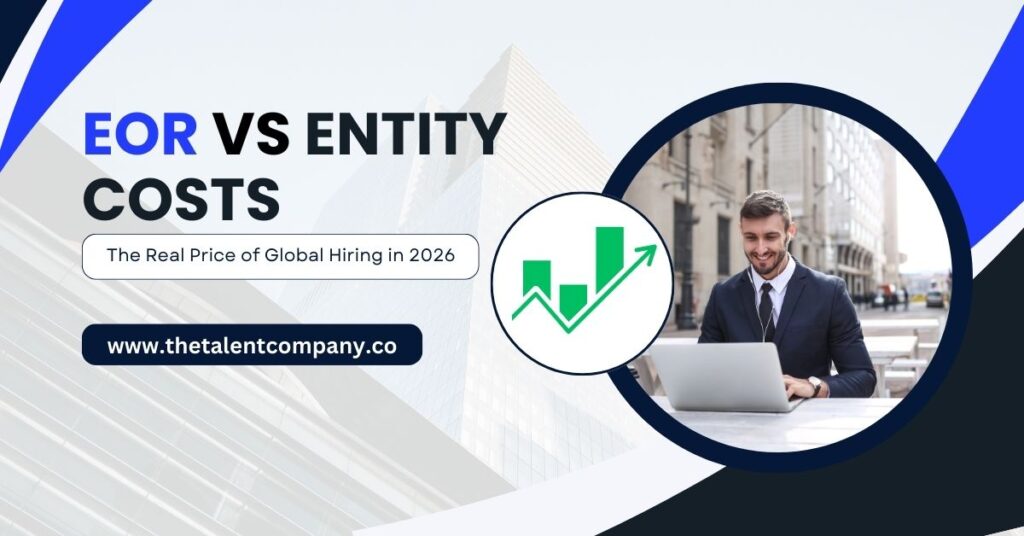
When comparing EOR vs entity costs, the real cost of global hiring in 2026 goes far beyond salaries and surface-level expenses.
The prospect of going global may seem extremely attractive initially, with new markets to be explored, new customers to be served, and new talent to be utilized. However, there is a financial truth behind the international hiring, which most companies fail to notice.
Although it is a usual practice that leaders consider salaries as the highest cost of international hiring, the actual expenses can be hidden. Legal frameworks, compliance malpractices, payroll, taxation, missed revenues, administrative overheads, and regulatory risks can have a serious bottom-line implication. Unluckily, most organizations learn this only when they are stuck in their steps and incur unforeseen costs after several months.
As far as the international hiring process is concerned, there are two broad avenues always available to companies often also compare EOR with PEO and AOR models before making a final decision, which include the services of an Employer of Record (EOR), or the creation of a domestic legal entity. Both options have both benefits, but it is important to know the implication regarding speed, flexibility, risk, and costs in general. This guide offers a comparison of EORs and entity setups in a detailed manner and assists you to make a wise choice that does not only match your budget but your growth strategy too.
EOR and it’s Role?
An Employer of Record is a third-party service that legally employs workers on your behalf in countries where you do not have your own registered business. You manage the employee’s work.
The EOR manages everything else:
- Payroll processing
- Tax withholding and reporting
- Employment contracts
- Benefits administration
- Compliance with local labor laws
- Terminations and offboarding
This allows you to hire globally without setting up a legal presence in each location.
An EOR removes legal and administrative barriers, enabling companies to expand quickly while staying compliant.
What Does It Mean to Set Up Your Own Entity?
Establishing your own entity entails establishing a legal business in a different country. This may be a branch office or a subsidiary. After registering, your company would qualify as the legal employer and be responsible to the full extent, as regards:
- Employment law compliance
- Payroll and tax filings
- Data protection
- HR infrastructure
- Regulatory reporting
- Audits
- Corporate tax obligations
You gain full control, but you also take on full legal and financial risk.
Setup Costs: Where the Money Really Goes
When companies talk about “global expansion costs,” they usually think about employee salaries. In reality, salaries are only a fraction of what you pay when entering a new market. The true cost of international hiring begins before your first employee is even onboarded.
The difference between using an Employer of Record and setting up your own legal entity is not just legal structure. It is the difference between fixed, predictable costs and layered, compounding expenses that grow every month.
Let’s break down what you are actually paying for.
Setup Costs with an Employer of Record (EOR)
An EOR removes nearly all the traditional setup barriers. There is no need to establish a company, open a local bank account, or register with government authorities.
Your cost structure is simple and transparent.
Typical EOR setup includes:
- A monthly service fee per employee
- Statutory benefits and employer contributions
- Payroll processing and tax filings
- Employment contracts and compliance administration
There are no incorporation costs, no legal formation fees, no banking requirements, and no infrastructure investments.
This means you can start hiring without capital-heavy commitments or long approval cycles. Your costs scale only when your team grows.
Setup Costs with Your Own Legal Entity
Setting up an entity is not a single cost. It is a chain of mandatory financial and administrative steps that must happen before you can legally operate or hire.
Here is where the money typically goes:
1. Legal and Incorporation Expenses
Before anything else, a company has to be legally registered. This usually requires:
- Business name registration
- Articles of incorporation
- Registered documents with the government
- Registration of corporate taxes
- Professional legal assistance to comply with local legislation
These fees vary widely by region, but they are unavoidable.
2. Accounting, Audit, and Financial Structuring
Licensed professionals will be required to:
- Structure your business for tax compliance
- Implement financial reporting systems
- Prepare financial statements that are statutory
- Register necessary corporation and employment taxes
Audits are also compulsory in most jurisdictions irrespective of the size of the company.
3. Banking and Capital Requirements
Most regions require:
- A local business bank account
- Minimum capital deposits
- Proof of financial solvency
Opening these accounts often requires in-person verification, notarised documents, and regulatory approvals.
4. Payroll and HR Infrastructure
Before hiring, you must build a local employment system:
- Payroll software or payroll providers
- HR policies aligned with local labor law
- Benefit structures and pension schemes
- Insurance and social contribution registrations
These systems are complex and require ongoing maintenance.
5. Licensing, Permits, and Regulatory Filings
Depending on the industry, you may also need:
- Business operating licenses
- Employment permits
- Industry certifications
- Local compliance registrations
Each step adds time, cost, and legal risk.
Upfront Capital Requirements: The Cost of Entry
The most immediate differentiator is the initial cash outlay required to begin operations.
Entity Setup Costs
Establishing a legal entity is a capital-intensive project. Upfront expenses often include:
- Registration & Legal Fees: $10,000 to $50,000+, depending on the complexity of the jurisdiction (e.g., Spain can cost up to $120,000).
- Minimum Paid-in Capital: Many countries require a significant cash deposit in a local bank account (e.g., often ₹1 Lakh+ in India) before operations can start.
- Physical Infrastructure: Most countries mandate a physical registered office address, necessitating lease deposits and utility setups.
- Expansion Consultants: Fees for local lawyers, tax advisors, and fixers to navigate local bureaucracy.
EOR Setup Costs
In contrast, EORs typically have zero to minimal setup fees. Most providers charge a one-time onboarding fee per employee (ranging from $500 to $2,000) or waive it entirely for larger teams. This allows companies to redirect capital toward hiring and product development rather than legal filings.
Recurring Operational Costs: Fixed vs. Variable
The break-even point between these models is usually determined by how the recurring costs scale with your headcount.
The EOR Fee Structure
EORs generally use one of two pricing models:
- Flat Fee: A fixed monthly charge per employee, typically ranging from $199 to $800 depending on the provider and region. Premium global providers often sit at the higher end of this scale.
- Percentage of Payroll: A fee of 8% to 15% of the employee’s gross salary. While this sounds scalable, it can become expensive for high-earning senior executives.
The Entity Maintenance Burden
Once an entity is live, you face a massive “fixed cost” base that exists regardless of your headcount:
- Annual Compliance & Reporting: Fees for local audits, tax filings (GST/VAT), and corporate secretarial services. In India, this can range from $5,000 to $10,000 annually.
- Internal HR/Admin Salaries: You will likely need at least one local HR or finance manager to oversee local compliance, which adds $30,000–$60,000/year to your overhead.
- Tech Stack Costs: Managing an entity requires fragmented local systems for payroll, benefits, and HRIS. Deel highlights that these “tech stack” costs can lead to duplicate functions and overspending.
For the full country-specific cost picture in India — including statutory contributions like Provident Fund and gratuity, professional tax, current EOR fee bands, and what entity setup actually demands locally — see our dedicated guide to EOR services in India.
The Hidden Costs of Entity Ownership
Beyond the invoices from lawyers and landlords, there are two ghost costs that often surprise expanding businesses.
A. Permanent Establishment (PE) Risk
If you set up an entity, you are subject to local corporate taxes on profits attributed to that location. An EOR acts as a compliance shield, often preventing you from triggering permanent establishment risk, which can save millions in potential back-taxes.
B. Management Time (Opportunity Cost)
Perhaps the most underestimated cost. An India Site Lead may spend 30% of their time chasing compliance and execution issues (banking delays, document resolution, etc.) rather than building product. If that lead earns $240,000, that is an $72,000/year “hidden cost” of management drag.
How to Decide Between an EOR and Your Own Entity
- An Employer of Record allows you to start hiring within days, while setting up your own entity can take several months before you can legally employ anyone.
- Companies that are entering a market for a short or uncertain period benefit more from an EOR because it avoids long-term financial and legal commitments.
- Businesses planning to operate in a market for several years may justify the investment in a legal entity.
- Smaller teams are usually more cost effective under an EOR model because the fixed costs of running an entity are spread across fewer employees.
- As team size grows and becomes stable, an entity can become financially practical because operational costs are shared across a larger workforce.
- Many companies use a hybrid model by owning an entity in one core location and using EOR services in other regions for flexibility.
- Companies that require physical offices, manufacturing operations, or local customer contracts often need their own legal entity.
- Fully remote and digital-first teams can operate efficiently through an EOR without setting up local infrastructure.
- Exiting a market through an EOR is faster and less expensive than closing a legal entity.
- Closing a legal entity usually involves long timelines, regulatory processes, and additional costs.
- The right choice depends on your growth stage, budget, risk tolerance, and long-term expansion strategy.
Final Thoughts
The peculiar benefits of the EOR (Employer of Record) system compared to the conventional organization formation is an important concept to grasp in the companies that plan to streamline through international growth. EOR model suits well with businesses, which need a quick entry into the market and flexibility in their operations, especially when testing the new territory or creating remote technology centers.
The entity set up, conversely, excels at long-term strategies when the operation has more than 100 employees. This will not only result in asset ownership by the locals and bidding contracts to local governments but also make the brand strong and lasting to send a message of commitment to the local market and the community over the years.