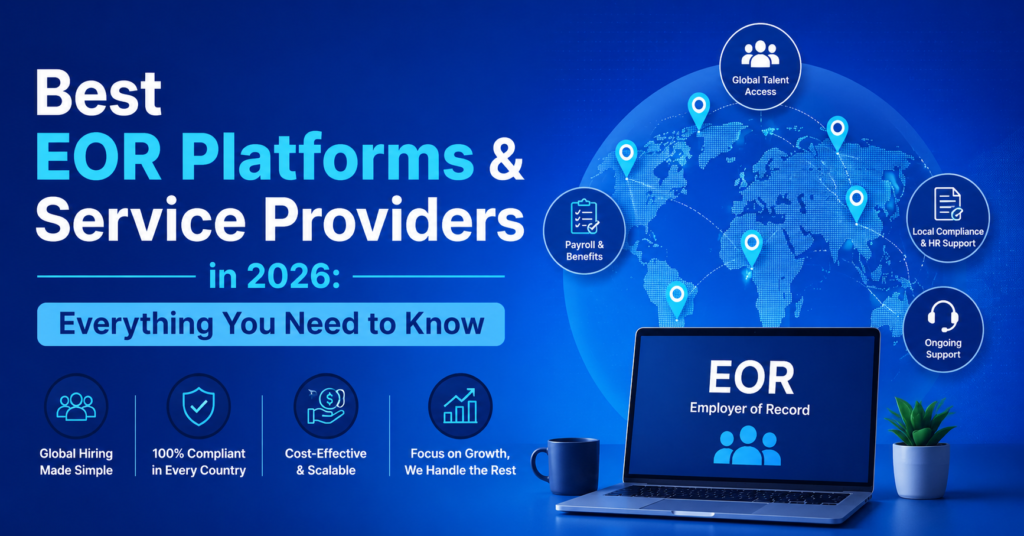
Hiring talent across borders sounds exciting until you hit the wall of legal entities, local labor laws, and payroll compliance. That’s where EOR platforms step in.
An Employer of Record (EOR) service lets businesses hire employees in any country without setting up a local company. The EOR becomes the legal employer, handling everything from contracts and payroll to benefits and tax compliance. They take care of the legal load, while you remain responsible for the actual work.
The global EOR market is growing faster than ever. More businesses are going remote-first, tapping into international talent pools, and trying to move faster than traditional HR setups allow. This guide breaks it all down.
Why More Businesses Are Choosing EOR Services in 2026
The shift toward EOR isn’t a trend, it’s a structural change in how global teams are built. Here’s why:
- Speed to market matters more than ever: Hiring through traditional channels, forming a subsidiary, registering for local taxes, setting up payroll infrastructure, can take months. EOR platforms can have someone working for you within days.
- Remote-first culture is now mainstream: Companies are now normalizing hiring wherever talent exists. That means crossing borders constantly. EOR services are the operational infrastructure that makes this possible.
- Compliance risk is real and expensive: Employment law mistakes including misclassifying workers, missing a statutory filing, failing to provide mandated benefits can result in fines, lawsuits, and reputational damage. Businesses should also understand Contract labor vs Employee classification rules to avoid compliance problems. EOR providers carry that risk so you don’t have to.
- Testing new markets is cheaper: Instead of committing to a full entity setup just to hire three people, businesses use EOR to pilot a market. This approach is common for companies exploring EOR Services in the Philippines or EOR Services in India before opening a local entity. If it works, they scale. If it doesn’t, they exit cleanly.
Top EOR Service Providers in 2026
Here’s a breakdown of the leading platforms:
1. Wisemonk
Wisemonk is a highly specialized EOR platform with a sharp focus on the talent-rich markets of South and Southeast Asia. With pricing starting at $99 per employee per month, it’s one of the most cost-effective options available, without cutting corners on compliance. It handles payroll, statutory benefits, equipment procurement, tax optimization, and even contractor payments. Onboarding typically takes one to two days. Best suited for companies hiring in Asia who want deep local expertise rather than a one-size-fits-all global platform. It is also considered among the Best EOR Platforms for Software Companies hiring remote developers across Asia.
2. Deel
Deel has grown into one of the most recognized names in global employment, supporting hiring in over 150 countries. It owns its legal entities in most markets, which gives it strong compliance control. Its platform integrates with more than 20 business tools, and it handles everything from full-time EOR to contractor management. Pricing starts at $599 per employee per month, a significant investment, but one that comes with serious infrastructure. Best for mid-to-large companies that need multi-country coverage and advanced automation.
3. The Talent Company
The Talent Company goes beyond standard EOR services by helping businesses build offshore teams that are stable, scalable, and cost-efficient. TTC isn’t just a payroll provider; it’s a strategic partner. They specialize in building dedicated offshore teams that integrate seamlessly into your organization. They handle hiring, compliance, and workforce operations with enterprise-level accuracy, but you have complete control over the execution and results.
4. Multiplier
Multiplier positions itself on speed and simplicity. The platform can onboard employees in under 24 hours, supports multi-currency payroll, and offers competitive pricing starting around $400 per employee per month. It’s particularly strong in the Asia-Pacific region and integrates with popular HRIS tools like BambooHR and Workday. A good fit for startups and scale-ups that need to move fast without getting tangled in complexity.
5. Remote
Remote takes a compliance-first approach, owning its entities in every country it operates in, no local partners, no middlemen. It’s built for teams that take IP protection seriously, with a proprietary IP Guard feature that’s especially relevant for tech and R&D companies. Pricing starts at $599 per employee per month on an annual plan. Its mobile app and employee self-service features are genuinely well-built. Best for companies where compliance and data security are non-negotiable.
6. Papaya Global
Papaya Global is an enterprise-grade platform combining EOR, payroll, and contractor management across 160+ countries. Its AI-powered tools include budget tracking, anomaly detection, and automated compliance alerts. Pricing typically starts at $599 to $650 per employee per month. If your business needs deep analytics, audit-ready reporting, and advanced workforce intelligence, Papaya Global delivers on that front.
7. Globalization Partners (G-P)
One of the longest-standing players in the EOR space, G-P offers premium services with coverage in 180+ countries. It includes an AI compliance assistant, a broad global network of legal experts, and strong onboarding speed. Pricing starts at $699 per employee per month, and clients are usually required to commit to a 12-month contract. Some users report unexpected fees for setup, wire transfers, and offboarding, so read the contract carefully. Best for established enterprises expanding to multiple markets simultaneously.
8. RemoFirst
RemoFirst is built for budget-conscious teams, startups and smaller businesses that need a compliant, affordable way to hire globally. Pricing starts at $199 per employee per month, with contractor management available from $25. The platform doesn’t own its entities but works with vetted local partners that bring solid compliance expertise. Onboarding can happen in as little as 24 hours. A strong choice for first-time global hirers who don’t need enterprise-level features at enterprise-level prices.
9. Rippling
Rippling is a unique entrant because it’s not just an EOR, it’s an all-in-one HR, IT, and finance platform. You can manage payroll, benefits, device provisioning, app access, and expense management from a single system. For EOR specifically, it operates in 50+ countries. Pricing is typically in the $499 to $599 range per employee per month. Best for tech companies that want to consolidate their entire employee lifecycle management in one place.
What to Look for When Evaluating EOR Service Providers?
Not all EOR platforms are built the same. Before you sign anything, here’s what deserves a hard look:
1. Entity Ownership Model
Some EOR providers own their legal entities in the countries where they operate. Others rely on local partners. Owned-entity models typically offer faster issue resolution and tighter compliance control. Partner-based models can still work well, but they add a layer of complexity.
2. Speed of Onboarding
A good EOR should be able to onboard a new employee within 24 to 48 hours. Anything beyond 5 to 7 business days is a sign of process inefficiency or understaffing.
3. Transparent Pricing
EOR pricing typically runs on a per-employee, per-month model. The range across providers is wide, anywhere from $99 to $699 or more per employee monthly. Watch for hidden charges like setup fees, offboarding costs, currency conversion markups, or premium support tiers that should be standard.
For a deeper view of what drives those numbers — by country, by role complexity, by pricing model — see our detailed breakdown of how much an EOR actually costs.
4. Compliance Depth
Generic global compliance knowledge isn’t enough. Your EOR needs to understand the specific employment laws, tax obligations, and statutory benefit requirements in every market where you’re hiring. The details matter and they vary significantly by country and even by region within a country.
If you’re hiring in the United States specifically, state-by-state labor law variation makes compliance depth even more important — see our guide on EOR services in the USA for state-level employment laws, payroll taxes, and benefits expectations.
5. Quality of Employee Experience
Your employees are interacting with the EOR on payslips, benefits enrollment, tax documents, and time-off requests. If their experience is poor, it reflects on you as an employer. Look for providers that offer employee self-service portals, fast support response times, and clear communication.
6. Integration Capabilities
Your EOR platform should connect smoothly with the HRIS, payroll, or accounting tools you already use. Strong integrations are especially important when implementing What is Managed Payroll systems across multiple countries. Platforms that require manual data entry or constant back-and-forth by email create operational friction.
Common Mistakes Companies Make When Choosing an EOR
Even smart teams get this wrong. Here’s what to watch out for — and for a deeper view of compliance, IP, and operational risks that come with the EOR model itself, see our breakdown of Employer of Record risks.
- Choosing based on price alone: The cheapest EOR isn’t always the best value. If compliance gaps create legal risk or payroll errors damage employee trust, you’ll spend far more fixing problems than you saved upfront.
- Not asking about entity ownership: This question gets skipped surprisingly often. The answer dramatically affects how fast problems get resolved.
- Ignoring employee experience: You’re asking your team members to trust a third party with their paycheck and tax documents. Poor EOR support creates friction, dissatisfaction, and churn.
- Locking into a long contract before piloting: Some providers push for 12-month minimums. If you’re testing a new market, push back on this or find a provider with more flexible terms.
- Underestimating currency and conversion fees: Certain EOR platforms impose currency conversion markups of 2% to 5% that aren’t made explicit up front. Always ask what happens when payroll is processed in a foreign currency.
Final Thoughts
EOR platforms have fundamentally changed how global teams are built. What used to require months of legal setup, local legal counsel, and substantial capital investment can now be done in days with the right partner.
The best EOR service provider for your business depends on where you’re hiring, how many employees you need to manage, what your compliance risk tolerance looks like, and what you’re willing to pay. There’s no single best answer, but there’s definitely a best answer for your specific situation.
Before committing to long-term contracts, take the time to properly analyze pricing structures and ask the necessary questions. A good EOR partner becomes a genuine competitive advantage, not just a compliance checkbox.