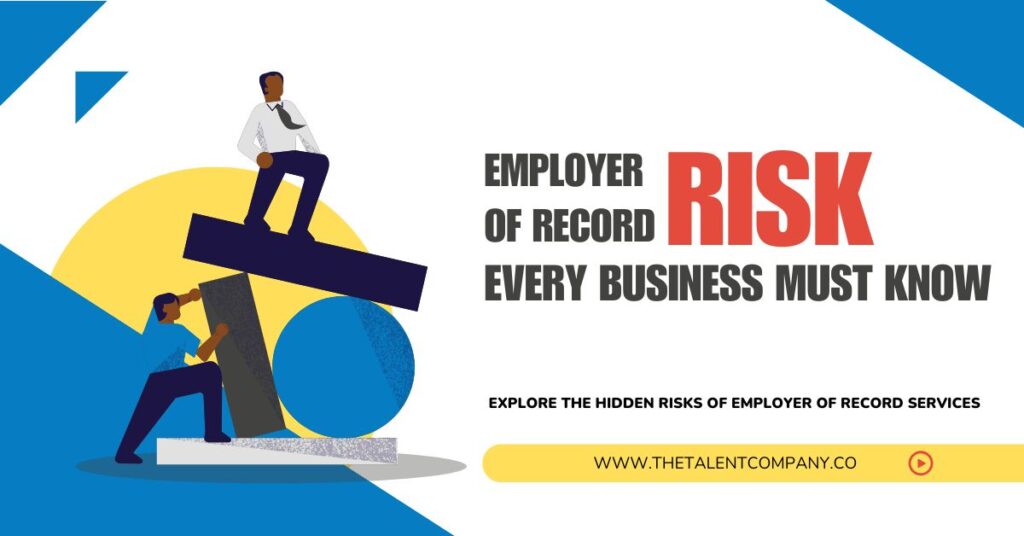
Employer of record risks can quietly create compliance, legal, and cost challenges that many growing businesses don’t notice until it’s too late.
Global hiring is no longer a long-term ambition. For many companies, it has become a business necessity.
Access to international talent allows organizations to move faster, reduce costs, and close critical skill gaps. But global expansion also introduces legal, tax, payroll, and compliance challenges that most companies are not equipped to handle internally.
That is where the Employer of Record model comes in. An Employer of Record, or EOR, allows businesses to hire employees in new markets without setting up a local legal entity. On the surface, it sounds like the perfect solution. You gain speed, compliance support, and administrative relief in one arrangement.
The EOR model is not, however, risk-free. Companies tend to believe that when they use an EOR, all the compliance and operational risks are transferred as a matter of course. In reality, many of those risks still impact your business directly, even if the EOR is technically the legal employer.
If you are considering an EOR, this guide will help you understand the most critical risks, how they affect your business, and what you can do to protect yourself before signing any contract.
Employer of Record and It’s Risk
Employer of Records (EOR) is a third-party service, which legally hires workers on your behalf. They do payroll, taxes, benefits, employment contract, and local labor compliance as you direct the day to day work of the employee.
In this model, the businesses can employ foreign workers within days rather than months. It eliminates the establishment of foreign entities and simplifies administration.
While the model offers major advantages, it also introduces new layers of dependency, financial exposure, and legal responsibility. Understanding those risks is essential before you commit.
1. Aggregator Models and Lack of Direct Control
Not all EORs operate with the same structure. Some providers own and manage their own legal entities. Others rely on third-party partners in each location and act as intermediaries between you and the actual employer. This is known as the aggregator model.
While aggregator platforms may appear global, they often create serious operational risks:
- Service quality varies by region
- Accountability becomes unclear
- Issue resolution is slower
- Communication is fragmented
- Employee experiences become inconsistent
With multiple vendors involved, responsibility becomes diluted. When problems occur, it is often unclear who is legally liable or operationally accountable.
Why this matters
When you scale, consistency is critical. The disjointed nature of employment creates challenges in terms of standardization of policies, performance management and securing your brand.
How to reduce this risk
- Establish ownership of the provider entities.
- Contracts should be designated with a single legal employer.
- Inquire of the dispute accountable, payroll mistakes, and compliance failures.
- Request documentation of local operations
Working with a direct provider creates a single chain of accountability and allows you to scale faster with fewer surprises.
2. Worker Misclassification
Worker misclassification occurs when someone is treated as a contractor when the law requires an employment relationship.
This can happen easily when hiring across borders. Even if the EOR or your internal team makes the error, your business may still face:
- Back taxes and benefits
- Fines per misclassified worker
- Legal action
- Public reputation damage
Misclassification is one of the most expensive compliance failures for global employers.
How to reduce this risk
Choose an EOR with structured classification frameworks, legal reviews, and local compliance teams who evaluate each role before onboarding.
3. Permanent Establishment Exposure
International hiring can unintentionally create a taxable business presence in another market. This is known as permanent establishment risk.
It can happen when employees:
- Negotiate or sign contracts
- Represent the company commercially
- Generate revenue locally
- Perform executive decision-making
This may trigger new tax obligations, reporting requirements, and regulatory exposure.
How to reduce this risk
Your EOR should provide guidance on operational boundaries, role design, and compliance thresholds. Ongoing monitoring is essential to avoid tax surprises.
4. Payroll and Tax Liability
Payroll is the most risky components of the international employment. It does not only concern the timely remuneration of salaries. It is a complicated entanglement of calculation of tax, statutory contributions, reporting, and strict deadline, which differ in each jurisdiction.
Each place has its set of rules about:
- Income tax deductions
- Social security and benefit contributions
- Employer-paid levies
- Payroll filing schedules
- Payslip formats and record retention
A small error in any one of these areas can trigger serious consequences. When payroll is incorrect, tax authorities do not only hold the EOR accountable. In many cases, they will also pursue the client company, especially if the error involves underpaid taxes or missing filings. Penalties can include late fees, interest charges, and significant fines that accumulate quickly.
Payroll errors also damage employee trust. If people are paid late, paid incorrectly, or see inconsistent deductions, they begin to question the stability of the company. Over time, this can lead to disengagement, complaints, and even resignations.
There is also an operational impact. Payroll mistakes consume leadership time, create internal fire drills, and distract teams from core business priorities.
How to reduce this risk
To manage payroll risk effectively, your EOR must operate with the same rigor as a financial institution. Look for providers that use audited payroll systems, have built-in compliance checks, and provide clear, transparent reporting.
They should also have in-house payroll specialists who understand local regulations and can handle complex scenarios such as promotions, bonuses, terminations, or role changes.
Strong payroll governance is not optional. It is essential to protecting both your people and your balance sheet.
5. Intellectual Property Ownership Issues
When your business hires internationally, intellectual property protection becomes far more complicated than most leaders expect.
In some legal systems, the default assumption is that the individual creator owns the work they produce, even if they are employed by your company. Unless contracts are written correctly and comply with local laws, your business may not automatically own:
- Software code
- Product designs
- Written content
- Research data
- Marketing assets
This creates a major business risk. If your company cannot clearly prove ownership of its IP, it can delay fundraising, block mergers or acquisitions, and even lead to legal disputes with former employees. In highly competitive industries, losing control of your intellectual property can seriously undermine your market position.
Many companies only discover this risk when they try to commercialize a product, file a patent, or raise capital and are asked to demonstrate ownership.
How to reduce this risk
Your EOR must ensure that every employment agreement includes locally enforceable intellectual property assignment clauses. These clauses must be written in a way that aligns with regional legal requirements, not just copied from a standard template.
Confidentiality agreements should also be included to protect proprietary information that cannot be patented or copyrighted. This legal foundation is essential for safeguarding your most valuable business assets.
6. Employment Law and Compliance Failures
Employment regulations are not static. They change regularly, often with little notice. New labor laws, benefit requirements, wage standards, and termination rules are introduced every year.
If your employment practices do not reflect the most current legal requirements, your company may be exposed to:
- Regulatory fines
- Legal disputes with employees
- Forced back payments
- Reputational harm
Even well-intentioned companies can fall out of compliance simply by relying on outdated policies or incorrect assumptions.
Another common risk is inconsistent application of policies. If benefits, leave, or working hours are not managed correctly, employees may feel they are being treated unfairly, which can lead to complaints or legal claims.
How to reduce this risk
Your EOR should actively monitor regulatory changes and update contracts, policies, and procedures in real time. Compliance should be proactive, not reactive.
They must also have local experts who understand how regulations are applied in practice, not just in theory. This ensures that your workforce remains compliant while also being treated fairly and consistently.
7. Data Security and Privacy
When you hire globally, you collect and process large volumes of sensitive personal data, including identification documents, payroll records, tax details, and benefit information.
This data is a prime target for cybercriminals.
A single data breach can expose confidential information, disrupt operations, and severely damage your reputation. Regulatory penalties for data protection failures can be substantial and, in some cases, linked to a percentage of your annual revenue.
Beyond financial consequences, data breaches erode employee trust. People expect their personal information to be handled responsibly. If that trust is broken, rebuilding confidence can take years.
How to reduce this risk
Your EOR must operate with enterprise-grade security standards. This includes encrypted data storage, strict access controls, continuous system monitoring, and regular third-party security audits.
They should also have formal data protection policies, incident response plans, and compliance certifications that demonstrate their commitment to safeguarding information.
Data protection is not just an IT issue. It is a core business risk that must be managed with the same seriousness as financial or legal compliance.
Why Choose The Talent Company For EOR?
Global hiring only works when it is built on structure, compliance, and long-term planning. The Talent Company goes beyond basic Employer of Record services to help businesses create a workforce strategy that is stable, scalable, and financially sustainable.
We do not simply process employment. We design hiring models that support growth, protect your business, and deliver predictable results.
A workforce model built for scale: The Talent Company uses a flexible offshore team model that allows organizations to expand globally without sacrificing compliance or control. Our approach is designed to support rapid growth while maintaining operational stability, even as teams scale across multiple regions.
Full compliance: We take complete responsibility for local employment compliance, payroll accuracy, and statutory obligations. This significantly reduces your legal and operational exposure and ensures your workforce is always aligned with local regulations.
Stable, long-term teams: Instead of relying on short-term contracts or fragmented employment structures, we help you build permanent, engaged teams that grow with your business. This leads to higher retention, stronger performance, and lower long-term hiring costs.
Structured onboarding and workforce continuity: We provide standardized onboarding frameworks and continuity planning that minimize disruption and support smooth team integration. This ensures employees are productive faster and remain aligned with your company’s goals.
Strategic alignment with your business goals: Every employment model is tailored to your operational needs, workforce plans, and long-term objectives. We do not offer one-size-fits-all solutions. We build structures that match your growth strategy.
End-to-end employee lifecycle management: From onboarding to exit, we manage the entire employee lifecycle under a single governance framework. This creates consistency, reduces risk, and simplifies workforce administration.
Predictable operations across regions: By standardizing employment processes, policies, and compliance controls, we deliver operational predictability. You gain visibility, control, and cost stability as you scale your global teams.
By combining deep compliance expertise with a strategic workforce approach, The Talent Company helps organizations build global teams that remain cost-effective, resilient, and ready for long-term growth.
Final Thoughts
When done with the right partner and proper governance, the EOR model can open the global growth. EORs cut complexity; however, they do not cut risk.
The successful companies are those that go about EOR relationships strategically, carry out due diligence, and keep an eye on compliance, costs, and the experience of employees.
Before you expand, make sure your foundation is built on clarity, accountability, and long-term sustainability.