
EOR Vs Staffing Agency: Which Model Fits Your Global Hiring? Global hiring has become important for companies looking to grow quickly and efficiently. Hiring talent from around the world brings speed, flexibility, and cost savings. But, at the same time, it introduces legal, tax, and compliance challenges that can be hard for internal HR teams to manage. To address these challenges, businesses often turn to two common solutions: Employer of Record (EOR) and Staffing Agencies. Both enable international hiring, but they work differently, support different types of workers, and come with different responsibilities. This guide explains how each model works, their benefits and drawbacks, and helps you choose the right one for your business. What is an Employer of Record (EOR)? An EOR is a third-party service that manages your global employees in countries where your company doesn’t have a registered entity. The EOR handles employment responsibilities like payroll, benefits, taxes, and labor law compliance, while your company oversees daily work and performance. This model allows companies to expand into new markets quickly, hire talent without establishing a local entity, and ensure compliance with complex international employment regulations. What an EOR Usually Offers? An Employer of Record offers a legal and administrative framework for hiring talent in regions without a company entity, ensuring compliance with local employment laws throughout the hiring process. An EOR typically handles: Preparing and managing compliant employment contracts for local and international hires. Processing global payroll along with accurate tax deductions and filings. Managing statutory benefits, leave entitlements, and company-provided perks. Overseeing onboarding tasks, required paperwork, and background verification. Ensuring every employment decision stays aligned with local labor and tax laws. Supporting visa applications, work authorization, and relocation needs. Coordinating expense reimbursements and delivery of IT equipment. Managing employee exits, legal notices, and dispute handling when needed. Providing workers’ compensation coverage and required insurance policies. Based on industry data and real business use cases, EOR services help companies expand their global workforce while minimizing legal risks and maintaining efficiency. Pros & Cons of EOR Pros of Using an EOR: Easy scaling: Whether you need to grow or reduce your team, an EOR makes workforce adjustment simple and compliant. Lower administrative workload: Your internal HR and finance teams save time since the EOR manages onboarding, benefits, tax filings, and employment paperwork. Fast entry into new markets: An EOR allows your company to hire in new countries within days instead of waiting months to open a legal entity. Cost savings at the start: Compared to opening a subsidiary, using an EOR is far more affordable when you are testing a new market or hiring a few employees. Global access to talent: You can hire qualified people in multiple regions without worrying about local restrictions or entity setup. Stronger compliance protection: You avoid legal risks because the EOR handles all country-specific rules, including labor regulations, payroll laws, and tax requirements. Cons of Using an EOR: Possible communication or cultural gaps: Because the EOR manages certain HR functions, there can be alignment or communication challenges between their team and yours. Weaker brand connection: Employees hired through an EOR may feel slightly less integrated with your company culture since the EOR is their legal employer. Higher costs when scaling large teams: As your headcount increases, per employee fees can become more expensive than running your own local entity. Limited flexibility in benefits and policies: Since the EOR must stay compliant with local laws, you may not be able to customize packages as much as you’d like. Dependence on the provider: Your global operations rely on the EOR’s accuracy, data protection standards, and service quality. Less control over employment terms: Some policies and contract structures must follow the EOR’s frameworks, which may limit customization. What is a Staffing Agency? A staffing agency is also known as an employment or recruitment agency. It is a service that helps companies find and hire professionals for specific roles, often for temporary, project-based, or sometimes permanent positions. These agencies act as a bridge between businesses and candidates. Staffing agencies are especially valuable when organizations need to fill critical positions on short notice, scale teams for seasonal projects, or access specialized skills without a long-term hiring commitment. They allow companies to maintain productivity and flexibility while ensuring the right talent is in place for immediate needs. What a Staffing Agency Usually Offers? Staffing agencies help companies quickly fill open roles by finding qualified professionals for short-term or temp-to-hire needs, streamlining hiring and providing fast access to talent when workloads rise. A staffing agency typically handles: Managing payroll, attendance, and timesheets for temporary workers. Conducting early interviews and basic skills evaluations. Replacing talent if a placement is not performing as expected. Verifying references and running background checks. Supplying flexible workforce options, including temporary and contract roles. Screening candidates to match them with specific job requirements. Providing support with hiring plans and workforce strategy. Pros & Cons of Staffing Agency Pros of Using a Staffing Agency: Flexible staffing options: Companies can easily scale short term or project based workers up or down as business needs change. Industry knowledge: A staffing agency focuses on specific industries and understands hiring patterns, job requirements, and talent availability. Saves time: The agency takes care of sourcing, screening, and initial interviews, helping you fill roles faster. Reduced hiring risk: Detailed screenings, assessments, and background checks lower the chances of making a poor hiring decision. Access to more qualified talent: You gain access to a broad network of pre-reviewed candidates, including those with specialized expertise. Lower HR efforts and costs: You save on advertising, paperwork, payroll, and other admin tasks for temporary roles because the agency manages them. Cons of Using a Staffing Agency: Possible culture mismatch: If the agency doesn’t fully grasp your company’s values or work environment, the candidates they send may not fit well. Additional fees: Placement charges or markups from the agency can raise your overall hiring cost. Lower commitment from temporary workers: Short-term staff may not display the same long-term dedication or engagement as full-time employees. Limited influence early in the process: You have less control during the initial screening and shortlisting stages

How Much Does EOR Cost?
Expanding into a new country should speed up your growth, not drown your team in legal complexities, payroll problems, and compliance risks. However, for multiple US businesses, international hiring often leads to just that. Establishing a local entity can take months, cost tens of thousands of dollars, and compel leadership to navigate unfamiliar labor laws before any employee becomes productive. That is why Employer of Record (EOR) services have become a core part of modern global expansion strategies. But one question always comes first. How much does an Employer of Record actually cost? The answer depends on where you hire, how many employees you need, and what level of compliance and HR support your business requires. This guide breaks down EOR pricing in India, one of the most cost-effective and talent-rich EOR markets globally. If you are evaluating EOR services, this article will help you understand real costs, pricing models, hidden fees, and how to assess value beyond the monthly invoice. What Is an Employer of Record (EOR)? An EOR is essentially a partner that helps your company hire employees in another country. While you focus on the day-to-day tasks like managing performance and overseeing projects, the EOR takes care of all the legal and official aspects of employment. This means they handle things like contracts, payroll, and compliance with local labor laws, which allows you to focus on growing your team and business without the legal headaches. This includes: Local employment contracts Payroll processing and tax withholding Statutory benefits and insurance Labor law compliance Employee onboarding and offboarding For companies expanding into different countries, where labour laws vary by state and change frequently, this model removes compliance risk and speeds up hiring dramatically. Why Businesses Choose EOR over Creating a Legal Entity? Prior to cost, it is helpful to comprehend why EOR is frequently the recommended choice. Establishing a foreign subsidiary usually entails: Registration and legal incorporation Local representatives or directors Continuous tax returns and audits HR infrastructure and payroll systems High initial and ongoing expenses In India, the cost of company setup alone, ignoring internal HR and regulatory expenses, can range from $20,000 to $40,000. An EOR substitutes a fixed, per-employee fee for the entire structure. Employers can scale teams up or down without long-term commitments and employ in a matter of days rather than months. How Much Does an Employer of Record Cost Globally? Employer of Record pricing varies widely by country because it reflects differences in labour laws, statutory employer obligations, payroll complexity, and the overall cost of operating in each market. In cost-efficient hiring destinations such as India and parts of South and Southeast Asia, EOR fees typically range from $50 to $250 per employee per month. In emerging or mid-cost regions, EOR pricing generally ranges from $400 to $600 per employee per month. In high-cost markets such as the United States, the United Kingdom, and Western Europe, EOR fees are significantly higher, typically ranging from $650 to $1,100 or more per employee per month. Many EOR platforms have a standardised pricing model that simplifies budgeting. Regardless of the country, these start at about $599 per employee each month. This strategy makes budgeting easier for businesses that hire people from different areas. How Much Do Leading EOR Providers Charge in India? EOR pricing in India varies based on provider scale, service depth, and local expertise. By using local infrastructure and on-the-ground compliance teams, India-focused providers usually offer the most competitive pricing, ranging from $49 to $150 per employee per month. Mid-market international providers, who offer more extensive regional coverage with mild localization, typically charge between $250 and $400. Large international platforms that use uniform pricing across nations typically start at $599 per employee per month or more. Lower prices do not always equate to less services, but they do necessitate careful consideration. Businesses should examine what is covered by the base price, how local compliance is managed, and whether there are any additional fees. Employer of Record Cost in the Philippines For hiring through an Employer of Record (EOR), the Philippines is often compared to India, especially for customer service, financial operations, and service jobs. The Philippines has more required benefits and labor rules than India. The fees for hiring an employee through an EOR usually start at $190 per month. Companies often choose the Philippines for jobs that need strong English skills and a good understanding of US culture, even though it costs a bit more. Key Cost Components of EOR Services To gain a comprehensive understanding of EOR pricing, it’s essential to look beyond the seemingly straightforward headline monthly fee. The total cost comprises multiple components. You can understand the pricing details and makemore strategic decisions that fit your company’s requirements if you examine the following factors. 1. Employee Salary This is the agreed compensation for the employee, which includes base salary and allowances. Although not part of the EOR fee, the salary level often influences pricing in percentage-based models. 2. Statutory Benefits Indian law mandates several employer contributions, including: Provident Fund contributions Gratuity obligations Employee State Insurance for eligible roles Paid leave entitlements A reliable EOR makes sure that payments are calculated accurately and sent out on time. 3. EOR Service Fee This is the cost incurred by the provider for serving as the legitimate employer. Usually, it includes: Processing payroll Compliance with taxes Contracts for employment HR management Depending on the pricing strategy, fees could be fixed or based on salary. 4. Payroll Taxes Income tax withholding, professional tax, and state-specific levies are managed by the EOR and passed through transparently. 5. Insurance and Benefits Administration Many EORs provide statutory insurance as part of their services, while optional benefits, like private health coverage, are often available for an additional fee. This allows companies to tailor their employee benefits packages according to their specific needs. EOR Pricing Models Explained Most Employer of Record (EOR) providers use one of three common pricing structures. Understanding how each model works is very important for
AOR vs EOR: Understand the Difference and Choose the Right Model for Global Hiring
If you’re confused about which global hiring model fits your business, this guide on AOR vs EOR breaks it down in a simple, practical way so you can choose without risking compliance. Global hiring has become a strategic advantage for every fast growing company in the United States. Access to international talent gives businesses speed, flexibility, and cost efficiency, yet it also brings complex compliance requirements that most internal teams are not equipped to manage alone. In this environment, two models dominate the global hiring space. Agent of Record (AOR) and Employer of Record (EOR). They may sound similar, but they solve different problems and carry different levels of legal responsibility. Choosing the wrong structure can expose your business to misclassification issues, tax penalties, and operational delays. If you want to build a secure, compliant global workforce, you must understand the difference clearly. This guide explains AOR and EOR in simple terms, highlights the responsibilities of each, and helps you identify the model that aligns with your hiring strategy. What Is AOR and How It Works? Global hiring has become a strategic advantage for every fast growing company in the United States. Access to international talent gives businesses speed, flexibility, and cost efficiency, yet it also brings complex compliance requirements that most internal teams are not equipped to manage alone. Businesses use AOR when they want flexibility without assuming full employment obligations. The AOR verifies that the individual is eligible to work independently, manages essential documentation, and provides a compliant structure for payments. This model is suitable for project based work, short term support, and situations where the business does not need to integrate the individual as a Global Employee. Key Responsibilities of an AOR An AOR manages the compliance and administrative framework for independent work arrangements. Core responsibilities include: Validating that the individual is a legally independent entity. Collecting and reviewing tax documents and compliance records. Managing contracts for independent engagements. Assessing classification risks to prevent misclassification penalties. Coordinating invoice processing and payments. Ensuring adherence to local regulations governing independent professionals. Conducting periodic checks to confirm ongoing compliance. The AOR provides a structured approach that protects businesses from regulatory complications while maintaining flexibility. When to Use an AOR AOR is the right choice when the business needs: Project based or short term work. Support from an individual who already operates as an independent professional. Flexibility without employment obligations. A compliant structure for cross border payments. Limited involvement in day to day oversight or performance management. A temporary solution rather than a long term role. AOR is not suitable for ongoing and integrated roles that function like employment. In such cases, EOR is the correct model. What Is EOR and How It Works? An Employer of Record is a service provider that becomes the official legal employer for your full time Global Employees in countries where your company does not have a registered entity. Instead of opening a local branch or navigating complex regulations yourself, the EOR carries all the legal responsibilities tied to employment. This allows your business to hire talent in new regions while staying aligned with that country’s labor laws, tax rules, statutory benefits, and employment requirements. The EOR issues compliant employment contracts, manages payroll, deducts and submits taxes, administers benefits, and ensures the employee meets all regulatory standards. Meanwhile, your company directs daily work, sets performance goals, and manages the employee operationally. The EOR handles every legal and administrative burden so you can expand into new markets quickly without building a local entity or dealing with regulatory risk. Key Responsibilities of an EOR An EOR manages the entire employment lifecycle. Responsibilities include: Issuing fully compliant employment contracts. Running payroll according to local laws. Managing tax withholdings and statutory social contributions. Providing benefits and leave entitlements required by local regulations. Supporting compliant onboarding and termination processes. Managing documentation for audits and regulatory checks. Ensuring compliance with labor laws in each market. Protecting the client from legal liabilities tied to employment. Providing guidance on local HR practices and country specific norms. The EOR reduces risk and simplifies global hiring by managing all employment obligations end to end. When to Use an EOR EOR is the correct choice when your business needs: A long term Global Employee. Full compliance with payroll, taxes, and benefits. Integration of the individual into daily operations. Talent in markets where you do not have a legal entity. Faster hiring without complex administrative work. Predictable costs and protection from employment risk. Consistent global HR and compliance support. EOR enables companies to hire and scale globally without legal barriers or delays. Key Differences Between AOR and EOR Although both models involve third party support, the nature of the relationship is completely different. Below are the important differentiations. 1. Primary Function AOR: Supports companies in engaging independent professionals by ensuring their contractor status is compliant with local rules. It provides a safe structure for working with non-employee talent. EOR: Works as the legal employer for your Global Employees in countries where you do not have an entity. It handles all employment obligations on your behalf. 2. Type of Workforce Supported AOR: Ideal when engaging independent professionals who work as self-managed service providers without needing formal employment status. EOR: Used to hire Global Employees in full time or part time roles who require formal employment status. 3. Legal Relationship AOR: The worker remains independent and you remain their client. The AOR only oversees compliance and documentation. EOR: The Global Employee is legally employed by the EOR, even though your company directs their daily work. 4. Core Responsibilities AOR: Manages contractor classification, reviews legal documents, oversees compliant payment channels, and handles contractor contracts. EOR: Runs payroll, manages taxes, administers benefits, issues employment contracts, and ensures full labor law compliance. 5. Liability and Risk AOR: Does not take on employer liability. Its role is to reduce classification risk and protect the company from contractor-related violations. EOR: Assumes complete legal accountability as the employer including employment disputes, statutory obligations, and
PEO vs EOR: What Is The Difference And Why It Matters?
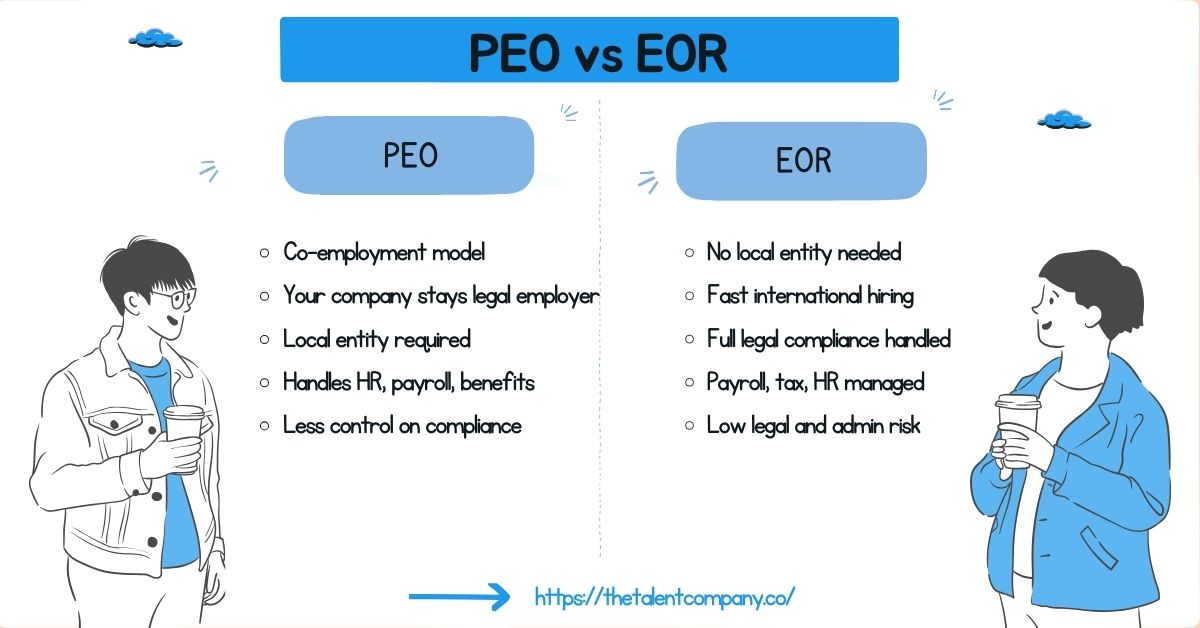
PEO VS EOR is one of the most important hiring decisions businesses face when expanding domestically or globally. It is an important business decision that affects your growth, risk management, spending, and scalability. For many US companies, hiring across borders has become a necessity, not a choice. But the moment a company decides to hire internationally, serious questions come up. Who is the legal employer? Who handles payroll, taxes, labor laws, and terminations? And how do you manage all of this without spending months? This is where PEO (Professional Employer Organization) and EOR (Employer of Record) come in. Both models are designed to simplify hiring. Both offer compliance support. Choosing the wrong option can lead to legal risk, higher costs, and operational complications. This guide explains the real differences between PEO and EOR. Read on to understand how each model works, where they are best used & which option makes the most sense for your growth plan. What is an Employer of Record (EOR)? An Employer of Record is a third-party service that legally employs workers on behalf of another company. While the employee works full-time under the client company’s direction, the EOR assumes full legal responsibility for the candidate’s employment. This model is widely used by companies that want to hire talent domestically or internationally without establishing a local legal entity. The EOR becomes the official employer, handling all employment-related legal and administrative obligations, while the client focuses on managing the employee’s day-to-day work. In practical terms, an EOR allows companies to access global talent quickly, compliantly, and with minimal operational overhead. Key Responsibilities of an EOR An EOR is responsible for every legal and regulatory aspect of employment. This includes: Legal Employment and Contracts: The EOR issues locally compliant employment contracts in accordance with country-specific labor laws. This ensures the correct classification of workers and reduces the risk of penalties for misclassification. Payroll Management: The EOR processes payroll, ensures accurate wage calculations, manages deductions, and guarantees timely salary payments in local currency. Tax Withholding and Reporting: All employee taxes are calculated, withheld, and submitted correctly by the EOR. This includes income tax, social contributions, and statutory deductions mandated by law. Labor Law Compliance: The EOR stays up to date with local employment regulations, including working hours, overtime rules, termination laws, and employee protections. Benefits Administration: Statutory and optional benefits such as health insurance, paid leave, and retirement contributions are managed by the EOR in line with local requirements. Termination and Offboarding: Employee terminations are handled compliantly, including notice periods, severance obligations, and documentation. When to Use an EOR An EOR is the right solution when speed, flexibility, and certainty of compliance matter. Common Use Cases for an EOR: Hiring international employees without setting up a local entity Expanding into new markets quickly Testing new geographies before long-term investment Managing remote or distributed teams across countries Reducing legal exposure to foreign labor laws For fast-growing companies, startups, and enterprises alike, EORs remove the traditional barriers to global hiring. What is a Professional Employer Organization (PEO)? A Professional Employer Organization (PEO) works through a co-employment arrangement, where both the PEO and the client company share employer responsibilities. The PEO handles HR-related tasks, including payroll processing, benefits administration, and compliance requirements. At the same time, the client company remains responsible for hiring decisions, day-to-day supervision, and overall employee management. In this model, employees are legally connected to both the PEO and the client company. The PEO manages HR operations and helps ensure regulatory compliance, while the client company focuses on running the business and directing the employees’ daily work. Key Responsibilities of a PEO A PEO shares employment responsibilities with the client company and manages core HR and administrative functions. Payroll Processing: The PEO manages payroll operations, including salary calculations, wage distribution, and payroll reporting. This helps ensure employees are paid accurately and on time. Benefits Administration: PEO handles employee benefits, including health insurance, retirement plans, and various other benefit programs. They assist with enrollment, changes, and ongoing administration. HR Services and Employee Support: PEO offers a full range of HR services, which may include employee onboarding, policy management, performance support, and employee training programs to help businesses develop and retain talent. Compliance Support and Regulatory Guidance: The PEO provides guidance on employment laws and regulatory requirements. While it helps manage compliance, legal responsibility is shared, and the client company remains partially liable. Workers’ Compensation and Unemployment Claims: PEO manages workers’ compensation coverage and assists with unemployment insurance claims, helping businesses reduce administrative burden and manage employment-related risks more effectively. Shared Employment Liability: Under the co-employment arrangement, both the PEO and the client company share certain legal responsibilities related to employment, including HR compliance and workplace policies. When to Use a PEO A PEO is appropriate when a company already has established operations in a specific country. A PEO is a good fit when: Your company already has a legal entity in the country where employees are hired. You want to outsource HR functions such as payroll, benefits, and compliance to reduce administrative workload. You prefer to retain full control over hiring, firing, and day-to-day employee management. Your business is looking for HR expertise and process support, not a legal employer replacement. You have long-term operations in the country and do not require rapid entry or exit flexibility. In these scenarios, a PEO helps streamline HR operations while allowing the company to remain the primary employer and maintain direct oversight of its workforce. PEO VS EOR: Key Differences While Employer of Record (EOR) and Professional Employer Organization (PEO) models may appear similar on the surface, they differ significantly in structure, responsibility, risk, and flexibility. Understanding these differences is important when choosing the right employment model for your business. 1. Legal Employer Status EOR: An Employer of Record is the legal employer of the workforce. It takes full responsibility for employment contracts, payroll, taxes, and compliance with local labor laws. PEO: A PEO operates under a co-employment structure. Both the PEO
What Is an Employer of Record (EOR)? A Complete Guide
Hiring employees outside the United States should be a growth accelerator, not a legal liability. However, for many US companies, international recruitment quickly becomes overwhelming and simple questions turn into roadblocks. Who manages payroll in another country? Which labor laws apply? Do we need to open a local entity just to hire one person? These uncertainties slow hiring, distract leadership, and delay expansion. This is exactly where an Employer of Record, or EOR, comes in. An EOR allows businesses to hire international employees legally and efficiently without setting up foreign subsidiaries. It removes compliance risk, cuts through administrative complexity, and enables companies to build global teams in a short time. This guide explains what an Employer of Record is, how it works, when to use it, and why it has become a core strategy for fast-growing US companies. What Is An Employer of Record (EOR)? An Employer of Record, or EOR, is a third-party service that legally hires employees on behalf of a client company. The EOR takes care of all employment-related administration, including payroll, taxes, benefits, and compliance with local labor laws. This setup allows businesses to hire talent in other countries without opening a local legal entity. It simplifies global expansion, reduces legal risk, and removes administrative burden. The client company still directs the employee’s day-to-day work, responsibilities, and performance. What Does An Employer of Record Do? An EOR takes care of all legal employment responsibilities while your company focuses on managing the employee’s daily work. Below is what EOR services typically cover: Supports international hiring: An EOR lets companies hire and pay employees in another country without setting up a local entity. This makes global hiring faster, simpler, and far less risky. Payroll management: The EOR calculates and pays salaries, handles multiple currencies for international teams, and processes expense reimbursements. Tax compliance: All required income taxes, Social Security contributions, and other employment taxes are properly withheld and filed with local authorities. Benefits management: The EOR oversees both mandatory and discretionary benefits like health coverage and paid leave. Legal and regulatory compliance: EOR ensures that employment practices align with both local and international labor laws. This includes providing fair contracts, supporting candidates’ compensation, and fulfilling unemployment requirements to create a safe and respectful work environment for everyone. Onboarding and offboarding: The EOR manages hiring and termination logistics, including paperwork, background checks, and legally compliant exit procedures. In short, an EOR acts as a trusted partner for businesses that want a fast, compliant, and low-risk way to hire employees in new locations without dealing with complex local employment laws on their own. What Are the Different Types of Employer of Record Service? Employer of Record (EOR) services can be categorized primarily based on their operating model. Different countries have different ways of operating for EOR providers, mainly because of their legal setup. Owned-Entity (Direct Model) EOR: This type of EOR establishes and operates through its own registered legal entities within the countries where it provides services. This model offers direct control over compliance and processes, often leading to better data security and service stability. Providers like Remote often use this model. Partner-Dependent (Indirect or Aggregation Model) EOR: These EORs rely on a network of third-party local partners or vendors to handle employment tasks in specific regions. This approach allows for broader international coverage without the significant investment of setting up an entity in every country, but the level of control and consistency may vary depending on the local partner. Hybrid EOR: This model combines the best of both approaches, using wholly-owned entities in key or high-demand markets and subcontracting to local partners in others. This offers a balance of flexibility and control across various regions. Benefits of Utilizing EOR Whether you’re hiring one employee or expanding into a new market, working with an EOR offers several practical advantages. Below are some of the key benefits companies generally notice: Lower costs: Setting up and maintaining legal entities in other countries is expensive and time-consuming. An EOR allows you to hire internationally through a predictable monthly fee, cutting down on ongoing overhead costs. Reduced risk: EORs take on legal employment responsibility and rely on in-country experts to stay aligned with local labor laws, helping protect your business from compliance issues. More flexibility: With an EOR, you can move quickly on hiring decisions or strategic changes. It’s easier to enter new markets or exit them without long administrative delays. Improved employee experience: Employees receive a consistent and compliant employment experience regardless of location, which supports fairness, inclusion, and a stronger workplace culture. Stronger employer brand: Using an EOR shows that your company values compliance and ethical employment practices. It also helps you avoid legal complications that could damage your reputation. How Does An EOR Work? The EOR model helps reduce the legal and administrative challenges of managing international employees. This allows companies to focus on leading your team instead of dealing with complicated employment rules. Here’s how an Employer of Record typically supports global hiring: Agreement and onboarding: You choose an EOR partner and sign an agreement that defines responsibilities, service scope, and fees. The EOR then prepares employment contracts that comply with local labor laws for your selected candidates. Legal employment: The EOR becomes the official legal employer of the workers in their country. While the EOR handles legal employment matters, your company continues to manage daily work, goals, and performance. Payroll and benefits: The EOR runs payroll, pays salaries in local currency, withholds required taxes, and manages both statutory and optional employee benefits. Compliance & risk management: The EOR monitors local labor laws, handles required filings, and ensures ongoing compliance, which helps your company avoid fines or legal issues. Ongoing support: Throughout the employee’s time with your company, the EOR manages HR paperwork, employment records, and legally compliant offboarding when needed. An EOR provides a structured, low-risk way to hire and manage global employees without dealing directly with employment regulations. What Is the Relationship Between an EOR, the Client
Benefits of RPO: How Outsourcing Talent Acquisition Drives Business Growth
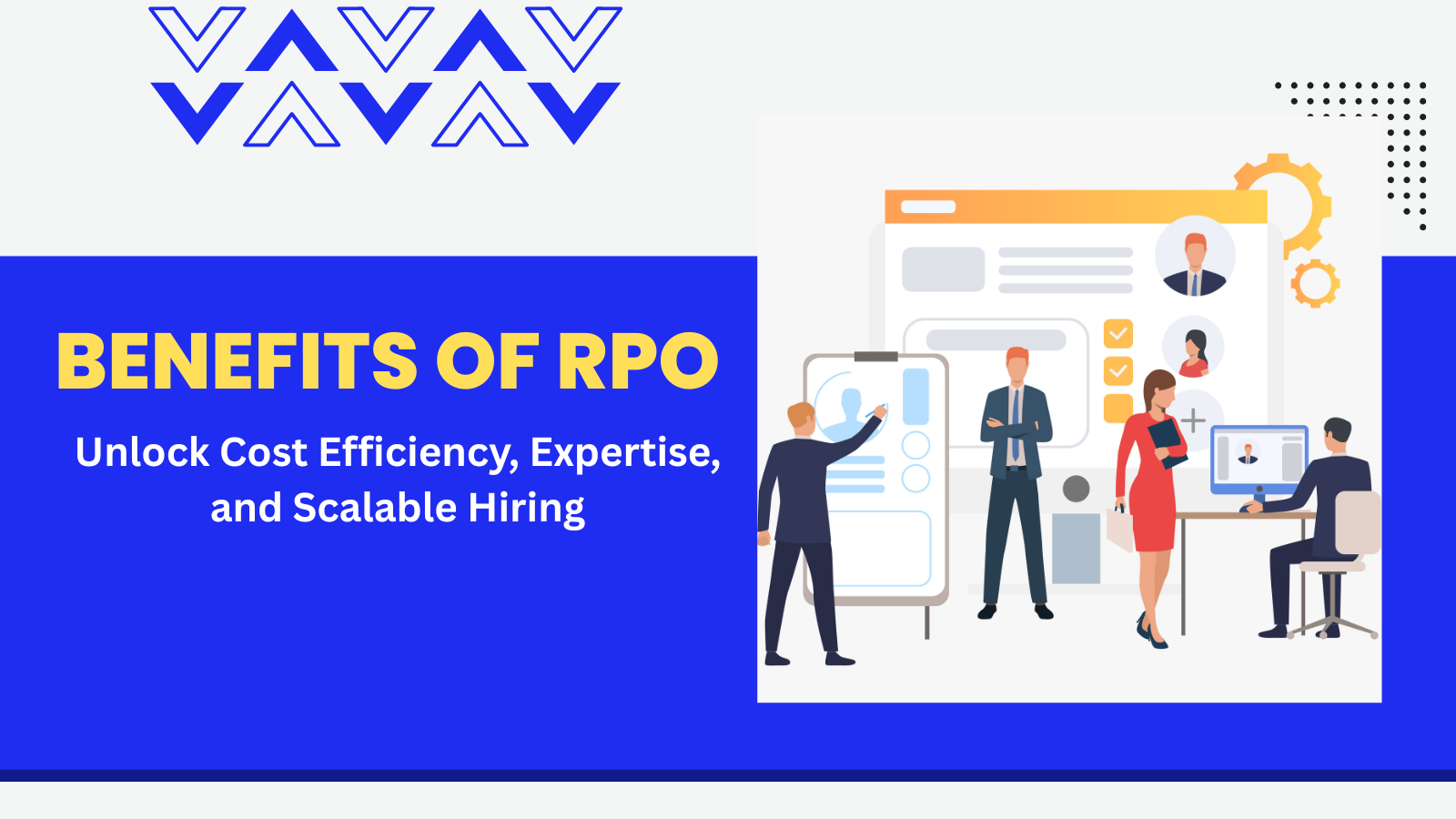
As hiring pressures are piling up for U.S. organizations, a lot of them are on the lookout for more sustainable ways to expand their workforce without compromising on quality or brand. Outsourcing talent acquisition has sprung up as a strategic alternative through recruitment process outsourcing (RPO), which can help turn a hiring burden into a growth strategy. Instead of completely depending on the internal hiring teams to take care of every vacant position, firms are increasingly using outsourced recruitment to attain expert knowledge and manpower. You will learn not only the benefits of RPO but also its assistance to business goals and the reason why talent outsourcing can be a source of real value to companies operating in the current cut-throat labour market. Outsourced Recruitment Solutions by The Talent Company At The Talent Company, we deliver bespoke outsourced recruiting solutions designed around your specific hiring profile, business strategy, and growth ambitions. Whether you are a mid-sized US enterprise scaling rapidly or a large organisation looking for enterprise-level RPO support, our model adapts. You benefit from: Strategic workforce-planning consultation and forecasting Access to broad talent networks and a high-quality candidate pipeline Technology-enabled workflows (including analytics, sourcing automation, candidate-experience platforms) Flexibility in delivery, whether full lifecycle RPO, project-based outsourcing, or hybrid models integrated with your internal HR team Partnership that respects your employer brand and aligns with your business goals If you are seeking a partner who offers more than “body-shop” recruiting and instead delivers the advantages of RPO in practice, The Talent Company is positioned to deliver. Key Benefits of RPO (Recruitment Process Outsourcing) RPO’s advantages are not just limited to hiring but also to transforming the company’s staffing into an indispensable contributor to growth. Here are the benefits of outsourcing recruitment a. Cost Efficiency and Faster Hiring RPO is one of the major factors that bring down hiring costs and time. The internal management of recruitment can be tough and tedious. On the other hand, companies that collaborate with an outsourced recruitment provider are the ones who enjoy the benefit of saving on advertising, job boards, and technology. RPO teams apply cutting-edge tools, automation, and skilled labor pools that they have built over time to achieve a 50% reduction in time-to-hire, which is a remarkable improvement in both speed and quality of hiring. b. Access to Specialized Expertise and Talent Networks Outsourcing talent acquisition provides businesses with access to recruiters who are not only very knowledgeable about the industry but also have very large professional networks. RPO partners are the ones who are specializing in sourcing the rare and high-demand skills and also keep the talent pipelines ready for the critical roles. Their knowledge assures quality hires, even in highly competitive markets. c. Enhanced Candidate Experience and Employer Branding For drawing the best talent, the way hiring is done has to be smooth and the process has to be transparent. The RPO partners will communicate very clearly, respond very quickly, and follow up, thereby increasing candidate experience and employer branding. Happy candidates would be the ones to apply again or recommend the company, thus strengthening the long-term talent attraction. d. Scalability and Flexibility The changing demands for hiring can put a lot of pressure on the internal HR team. But with the outsource recruitment solution, a company will be able to respond to the hiring needs immediately without increasing its overhead costs. This flexibility is a great asset almost always; especially during times like company expansions, mergers, or higher seasonal hiring activities. Thus, it is a way for the business to be agile and cost-efficient. e. Data-Driven Recruitment Decisions Present-day RPO vendors take advantage of analytics to monitor indicators among others like cost-per-hire, source efficiency, and conversion rates. Such understanding makes it possible for companies to take data-based decisions, to increase the recruitment budget’s ROI, and to foresee the future talent requirements. The data-driven employment makes certain about the hiring being consistent, transparent and more efficient on the front of the manpower planning. f. Compliance and Risk Management The recruitment process in the United States is governed by a myriad of strict labor laws, data privacy regulations, and equal opportunity laws. By outsourcing recruitment and selection process to a competent RPO partner, the companies not only ensure compliance but also minimize the risk of legal actions. This is particularly important in fields where the regulatory norms are very stringent, such as healthcare and finance. g. Higher Quality of Hire One of the most important benefits of outsourcing recruitment is the quality of candidates. The RPO specialists utilize behavioral assessments, structured interviews, and predictive analytics to make sure that the candidate’s values align with the company and the success is long-term. As a result, the company’s retention rates go up while the turnover costs go down. h. Diversity and Inclusion The services provided by the RPO companies guarantee that the diversity and inclusion targets set by organizations are being met. Through using the blind screening method, they strengthen equal opportunity hiring and thus, the diversity of the teams that not only enhances the organization’s innovation and culture but also its strength. i. Long-Term Strategic Partnership RPO is, unlike staffing agencies, a long-term partnership. This partnership makes sure that recruitment is not merely a matter of filling vacant positions; it is about fueling the continuous growth of the business. The Future of Outsourcing Talent The RPO industry is evolving with AI, automation, and data-driven recruitment leading the charge. The integration of predictive analytics, chatbots, and smart screening tools is reshaping how companies attract and evaluate talent. According to Grand View Research, the global RPO market is expected to reach USD 27 billion by 2030, with North America holding a significant share. The future of RPO lies in delivering hyper-personalized, tech-enabled, and agile recruitment experiences that align talent strategy with business goals. In this future, The Talent Company continues to lead by offering innovative, human-centered outsourcing solutions that bridge skill gaps and strengthen organizational capability. Conclusion The benefits of RPO extend far
Talent Acquisition Specialist: The Strategic Partner Your Business Needs
The process of hiring talent has changed over the years, and the difference between companies that stick to their old ways and those going with the new process reflects in their attitude toward hiring new talent. When organizations ask, “what is talent acquisition” they change their mentality and turn hiring from a routine operational necessity to handle, to a strategic investment that pays off. The TA specialist has a different role, they are the one who helps and guides the organization through the process of acquiring the right talent that can contribute to the future capabilities of the workforce. In this blog, we will look into the definition of a talent acquisition specialist, the role of a TA expert, the reasons why U.S. companies need them the most, the ways their talents are put to work, and how using external sources for certain parts of the recruitment process can be a plus for their function. What is a Talent Acquisition Specialist? If “what does a talent acquisition specialist do?” is one of the questions in your mind, here is your answer: the position of a Talent Acquisition Specialist is a highly strategic one in HR that oversees the whole process of bringing in, involving, selecting, and keeping relevant professionals that are in line with the long-term goals of a business. A TA specialist does not work like a conventional recruiter who is only concerned with filling urgent vacancies but instead they have a long-term vision, predicts the requirements of future skills, cultivates the interest of candidates, and promotes the employer brand. Partner with The Talent Company This is where The Talent Company plays an important role for your business. The Talent Company will provide you with professional knowledge, data-based tactics, and full execution. You can outsource your hiring process, and have a TA specialist onboarded for your brand, who knows the ins and outs of Talent Acquisition. Why U.S. Organizations Need Talent Acquisition Specialists Tight labour market & talent scarcity The U.S. labor market situation is still very dynamic. The available positions are in millions (7.2 million in August 2025) Therefore, it is important for the organization to hire relevant candidates for their brand. When the skilled professionals are less in the market and the positions are more, it is very important to have a member whose primary responsibility is to create connections, recruit, and polish the brand’s image. Strategic alignment and organizational growth As per a recent survey, only 32% of the TA leaders participate in strategic workforce planning, and on the other hand, 58% of the companies think that the lack of skilled workers is a major hurdle to their business plans. In this way: a lot of businesses still consider hiring as a cost or an administrative function. The presence of a talent acquisition specialist can help in changing this perception and viewing the talent pool as a strategic asset. Cost savings and better quality of hire The quality of hire has always been important, especially when turnover is costly and the hiring process takes too long. The quality of hire can be substantially improved by a well-executed talent-acquisition function headed by a skilled specialist. The workforce is being maintained for the future Talent acquisition specialists are in high demand especially in industries such as Technology, Healthcare, and Finance where roles are not only complex but also skill sets are changing and passive candidates’ presence is very important. Improved candidate experience and brand image of the employer Candidates have choices, and a poor candidate experience can harm employer reputation. The talent acquisition specialists guarantee that the whole process from the time candidates become aware of the job offering until they receive the offer is not only smooth but also personalized and effective, thus making the organization a preferred employer instead of a backup option. Recruiting strategies based on the data Talent acquisition specialists, with the help of analytics and sourcing intelligence, provide the insights on the location of talent, the most effective channels, the competition’s activities, and the areas of improvement for hiring workflows. Hence, the outcome is: more efficient, smarter investment in sourcing, selection, and retention. Outsourcing the Hiring Process: How It Integrates with Talent Acquisition Specialists Increasingly, U.S. companies are combining the internal expertise of talent acquisition specialists with external support through outsourcing the hiring process (e.g., Recruitment Process Outsourcing or RPO). This strategy leverages scale, specialist tools, and expertise to make the internal talent acquisition function better. How outsourcing supports the TA specialist Scalability: When hiring volumes spike or specialised hiring is needed, outsourcing provides additional capacity while the TA specialist maintains strategy and oversight. Tech & Analytics Access: External providers often bring advanced sourcing tools, predictive analytics, and talent-market intelligence that internal teams may lack. Faster Time-to-Hire: With external support handling more tactical tasks (postings, screening, scheduling), the TA specialist can focus on strategic sourcing and stakeholder management. Candidate Experience Enhancement: External partners can help deliver 24/7 candidate engagement, streamlined workflows, and best-practice processes, complementing the internal talent-acquisition strategy. Caution: Maintaining Strategy and Brand The TA specialist must still oversee employer brand alignment, candidate-experience standards, and strategic workforce planning. However, the brand must have an internal anchor to monitor. Market trends The growing need for outsourcing recruitment-process facilities indicates that talent acquisition support is getting more and more support. For instance, U.S. hiring managers are saying that they will fill new or vacant positions. This results in a strong case for companies to allocate resources and hire talent acquisition experts who can merge the internal strategy with external scale. Key Skills & Traits of an Effective Talent Acquisition Specialist The talent acquisition specialist must combine a wide range of skills and personality traits to be successful in this strategic position: Business savvy: Have a clear grasp of the organisation’s strategy, identify and understand the growth levers and the corresponding skills requirements. People-oriented approach: Create and nurture relationships with hiring managers, business leaders, and candidates. Data-oriented mind: Analyse data, track and assess metrics such

What Is Talent Acquisition? And How Does It Work
The way in which a company recruits basically says a lot about its future. Some companies give priority only to the process of filling up their vacant positions, whereas others lay more weightage on team formation that can expand along with the organization. That difference comes down to how they approach hiring, through recruitment or talent acquisition. If you have ever wondered “what is talent acquisition”, you are not the only one. A large number of people still think that it is just a new and different term for recruitment, but in reality, it is much bigger than that. Talent acquisition refers to finding, luring, and maintaining the right workforce, not just for the present but also for the long run. In this blog, we will describe in detail what talent acquisition is, how it works and what differentiates it from the traditional recruitment process. Besides, we will discuss the importance of a talent acquisition specialist and how the outsourcing hiring process is influencing the way the US market is shaping strong and future-ready teams. Let’s understand what talent acquisition is The talent acquisition process of an organization is proactive in identifying, attracting, selecting, and keeping individuals who will meet both the present and future business requirements. It goes beyond the mere act of filling a position. The guide indicates that it mainly focuses on the hiring strategy being in sync with the business strategy as a whole; pointing out the emphasis on the long-term fit, candidate experience, and the brand of the employer. A talent acquisition specialist is an important member of this team. This individual doesn’t just work to fill open positions but rather works in advance: creating talent pipelines, encouraging passive applicants, promoting the employer value proposition (EVP), monitoring metrics like hiring and retention, and partnering with business leaders to determine future hiring needs. Within the US, the position has increasingly become strategic rather than being just operational. When organizations think in terms of talent acquisition, the transformation is from “we need hires now” to “we are building capability for the future”. This transformation allows for better alignment between the talent and the business outcomes. In large US firms, the process of talent acquisition generally goes as follows: Planning of the workforce and assessment Before writing a job description, the talent acquisition team (often led by a talent acquisition specialist) collaborates with business leaders to understand upcoming growth, skills gaps, risk, and business strategy. This might mean forecasting shortages of key skills 12-24 months ahead. Promoting the Employer and building a Talent Pool In order to get the best candidates, companies have to create their brand: what it’s like to work there, the culture, the mission, and the opportunities, so that when the job openings are live, there is already a pool of interested and qualified people. This includes keeping a “talent community” of passive candidates. Getting and interacting with the Candidates With a brand message and pipeline, the sourcing starts: active postings, social media campaigns, contacts with passive talents, referrals, alumni networks. The specialist makes sure that the candidates’ engagement is steady, even when positions are not open yet. Evaluation and selection The process of candidate sourcing is followed by the assessment that consists of screening resumes, interviewing, judging the skills (both with job position and the company), testing soft and hard skills, and making offers. But in talent acquisition, selection also takes into account the future of the candidate, alignment with culture, retention, and adaptability. Onboarding The process continues after the hiring step. The talent acquisition strategy includes onboarding, development, internal mobility, and retention. The objective is not only to hire but also to nurture the talents in order to reduce turnover and encourage productivity. Analytics, continuous improvement and future planning The proactive and well-organized companies measure not only cost-per-hire and time-to-fill but a number of other factors as well. They keep track of quality of hiring, first-year retention, hiring-manager satisfaction, candidate experience, pipeline conversion, and even predictive analytics. Talent Acquisition vs Recruitment: Let’s understand the difference Feature Recruitment Talent Acquisition Primary objective Fill open positions quickly Build talent pipelines aligned with business strategy Time horizon Short-term (reactive) Long-term (proactive) Scope Operational hiring for immediate needs Strategic hiring, employer branding, pipeline development Candidate pool Mostly active job-seekers Active and passive candidates, talent communities Metrics Time-to-fill, cost-per-hire Quality of hire, retention, candidate experience, pipeline metrics If a US company decides to use talent acquisition instead of just recruiting, it means that it will not only respond to the hiring needs but also develop the future workforce. It can result in stronger employer branding, better retention, lower turnover costs, and gaining a competitive advantage in talent-demanding sectors. Outsourcing the Hiring Process: A Strategic Option One more aspect of the talent acquisition process in the US is the outsourcing of the hiring process which is sometimes done through Recruitment Process Outsourcing (RPO) and is likely to cover different aspects of the hire-to-onboard workflow. In simple terms, the company joins hands with a third-party service provider to take care of the whole or parts of sourcing, screening, analytics, employer branding, candidate engagement and onboarding. The outsourcing partner actually becomes a part of the hiring organization’s talent acquisition strategy. How to Hire: Best Practices for Effective Talent Acquisition Some actionable, practical steps (particularly for US-based firms) to construct or improve a talent acquisition function: Align with business strategy: Meet regularly with business leaders to understand hiring needs, skills gaps and growth plans. Strengthen employer brand: Write a strong value proposition to bring in active and passive candidates. Build talent pipelines: Build candidate communities, even where jobs don’t exist yet, and cultivate them. Leverage analytics and technology: Track quality of talent, retention, pipeline conversion, candidate experience, etc, use technology (AI, ATS) responsibly. Think intelligently about outsourcing: If resources are limited, collaborate with a third party, but make sure they fit your brand and strategy. Measure and iterate: Use data to continuously improve sourcing channels, screening filters, onboarding success, and retention
Talent Acquisition vs Recruitment: Building tomorrow’s workforce today
It is essential to modify the ways in which talent is recognized and retained in the modern workforce for reputable institutions, given the ever-changing nature of the job market. Simply filling in the blank spaces in the office isn’t enough anymore; for long-term growth and achievement, talent must be found, nurtured, and sustained. As a result, it is quite necessary to understand the meaning of talent acquisition and how strategic recruitment can help an organization reach its goals. Here, a talent acquisition company can help a lot, while the need to outsource the hiring process is also increasing among companies. The aim is simple: how to optimise the normal hiring process to bring the best out of long-term strategic benefits as well. As per the data of the Bureau of Labor Statistics (BLS), in August 2025 alone, there was a listing of 7.2 million job openings. All of these listings show that providing only vacancies and filling them is not enough anymore. Companies must look into acquisitions that are for the future. Recruitment and talent acquisition – What are the main differences? Even though most people use them as alternatives in layman’s terms, what is the difference between recruitment and talent acquisition? Some of the major differences are listed below: Dimension Recruitment Talent Acquisition Time horizon This is for filling immediate openings in a short term basis This is for building talent pipelines keeping long term goals in mind and by evaluating future needs Focus This is mainly done on a transactional basis, where the candidates are taken from the source, screened, and hired These are more strategic, where employer brands are seen, talent communities are observed, and skill planning is tested Metrics It usually requires more time to fill, and the cost depends on every hire This is more focused on the hire quality, more like retention, and it aligns more with the strategy of the business Trigger This mainly starts when a job opening occurs Here, the entire process is continuous, and the engagement of talent goes on Outcome It usually comes with a filled requisition The talent flow is sustainable, and all kind of future and current roles are considered If we talk in basics, recruitment mainly focuses on immediate hiring, while talent acquisition is focused on the talent the company needs, how the talent can be hired, and how the talent can be retained. Since the market is tight at present, this type of strategic recruitment is extremely critical. A lot of companies are outsourcing talent acquisition and recruitment today. Partner with The Talent Company Looking to boost your business with data-driven and optimised talent acquisition strategies? At The Talent Company, we do exactly that. From developing the brand of the employer to planning the workforce and hiring according to your company goals, we have got you covered. Looking to build such a workforce that ensures success? Connect with The Talent Company today for outsourced recruitment solutions. What is a Talent Acquisition Specialist’s Role The main role of a talent acquisition specialist is to approach the talent in the best way possible, on behalf of the company. The key responsibilities include: Identifying the critical roles that will be important in the next one to two years. Elevating the brand of the employer to such a level that talented employees will automatically be attracted to the company. Identifying potential talented candidates and preparing them to build a talent pipeline. Keeping a record of important metrics such as how much retention is being done of new hires, productivity, and hiring to business alignment goals. Making sure that the strategic talent planning aligns with the tactical hiring process. The role of a talent acquisition specialist is key to ensuring a company stays ahead with respect to its competition. Outsourcing the hiring process and why it is necessary With more and more requirements and the tedious process, companies often opt for hiring process outsourcing to experienced vendors. In the right hands, proper expertise is attained and efficiency is enhanced. Why are organizations outsourcing? When rapid scaling is required among a massive hire, the company cannot manage internally. Expert firms provide a deep analysis with market analysis, data analytics, and deep sourcing networks. Speed improvements are observed, and cost effectiveness is acquired by outsourcing talent. When is it beneficial? When urgent hiring and high-volume hiring are required For requiring talent pools and acquiring job-specific skills or niche skills When companies have the potential to build a capable infrastructure, but are not yet ready What to look out for? The employer brand and the company culture should be properly understood by the vendor. The metrics for hiring should match the long-term policy of the company. It is always necessary to maintain a necessary internal insight. Why is Talent Acquisition important now? The labour market is extremely competitive right now. As a result, normal recruitment may not help the company to achieve its long-term goals. In 2025, around 76% of employers are struggling with filling vacant roles. Massive job openings are still there. Around 7.2 million openings were listed in August 2025. There is a huge gap between the role requirements and skill level. As a result, more and more companies are focusing on long-term talent acquisition rather than just hiring when absolutely needed. How can a talent acquisition-oriented approach be implemented? The first steps towards achieving a proper talent acquisition are as follows: Identify the required talent – Companies should recognize which exact skillset they are looking for. Developing a brand – With the company being promoted as a reputed brand, talented workers will themselves opt to work there. Engaging Talent Pipelines – Creating networks, communities, and nurturing potential candidates is also very important. Taking Strategic Measures – Records should be kept of new hire performances, efficiency, and net output. Ensuring Outsourcing is Aligned with values – When the hiring process is outsourced, it is to be ensured that the core values and insights of the company are maintained. Being Ready
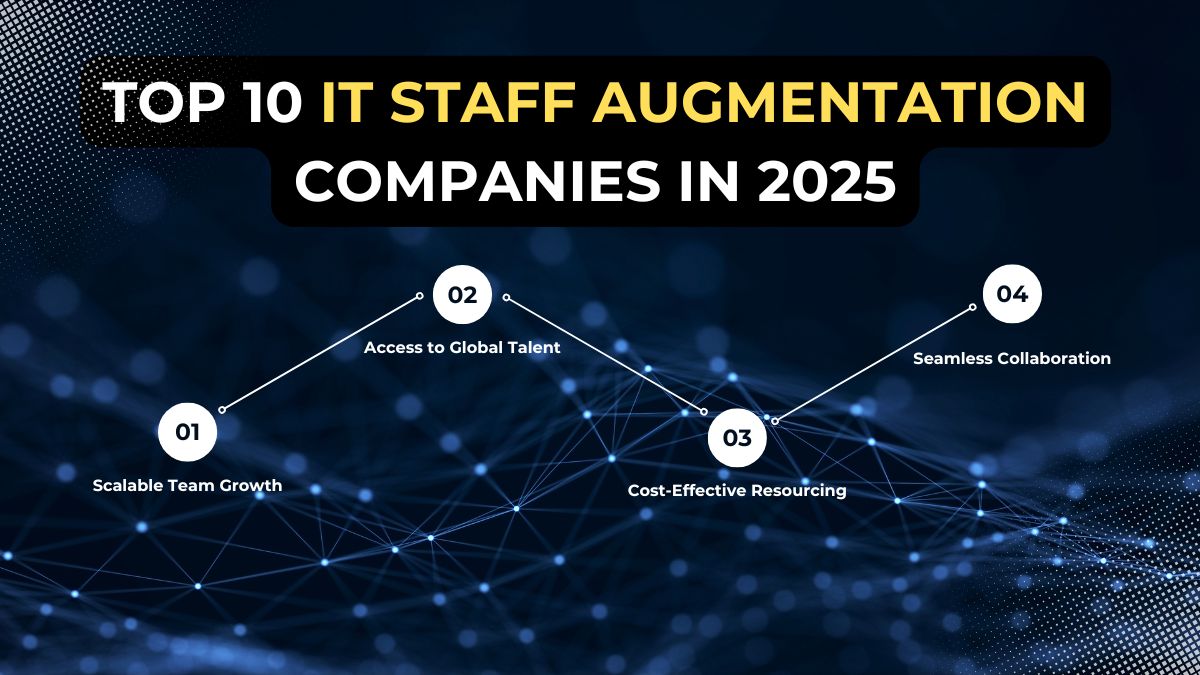
Top 10 IT staff augmentation companies you should know in 2025
The business needs in the digital era are changing and the way they operate. Businesses require agility in how they assemble and expand their technology teams. Recruiting full-time tech talent is slow, expensive, and inflexible. That’s why more firms are embracing IT staff augmentation as a smart method to tap into expertise, speed initiatives, and stay adaptable. In this blog, we will define the meaning of staff augmentation in the tech industry, explain why IT staff augmentation services are important today, provide a curated list of the top 10 providers to watch in 2025, and discuss key considerations when choosing the perfect tech staff augmentation partner. What does staff augmentation mean in the tech world? At its heart, staff augmentation is a workforce strategy where a business starts its internal team with outside professionals, contractors, experts, or consultants, who become part of that team and operate under the company’s management. In the tech realm, this turns into tech staff augmentation or IT staff augmentation services, where the third-party experts are software engineers, developing engineers, data scientists, UI/UX experts, cloud architects, cybersecurity engineers, etc. Rather than full-outsourcing, where an outside vendor keeps control of the entire deliverables, staff augmentation leaves control, workflows, and processes inside the hiring organisation while providing access to talent. The advantage is obvious: when you require specialized capabilities or have to scale fast, you’re not waiting for all the hiring, onboarding, and ramping up of full-time staff; you are adding experts as needed, integrating them fast, keeping control of your project. Why do IT staff augmentation services matter today? A few market forces are fueling the growth of IT staff augmentation. Talent shortages in high-demand technology means that firms can’t wait for full-time hiring seasons to catch up, and in industry directories, many companies also rely on vendor lists of pre-examined professionals standing by to be a part of internal teams, more than that, with the power to scale up or down based on project needs or even bring a single specialist on board for a few months. Businesses get cost and time-efficiencies, also with remote-work models now standardized, virtual staffing via these augmentation services implies that geographic limitations are less significant. Top 10 IT Staff Augmentation Companies Here is our list of the top 10 IT staff augmentation companies for 2025. This list starts with The Talent Company as the brand is in a very leading position, followed by nine other leaders. The Talent Company – An agile, strategic partner delivering staffing and augmentation services built around new-age tech needs their model stresses fast deployment, embedding with internal teams, and high retention of augmented talent. BairesDev – Known for providing senior technology talent, especially software engineers from near-shore regions aligned with U.S. time zones. Toptal – A high-end model providing access to top-level engineers and architects (typically in the top 1-3% worldwide), for high-impact tech work. Andela– Originally connecting African engineering talent with global companies, Andela now acts as a global tech talent network providing developers, data engineers, and cloud specialists for the U.S.-oriented firms. Collabera Inc. – A U.S.-based IT staffing and augmentation expert with deep enterprise experience on large-scale transformation and development engagements. Artech Information Systems – A long-standing U.S. player in IT staffing, augmentation, and consulting, with strong compliance and enterprise-scale capabilities. Netguru – European-based but highly attuned to U.S. clients, Netguru provides web, mobile, and SaaS-focused teams under augmentation models, mixing cost-effectiveness and expertise. Simform– A vendor focusing on web, mobile, and cloud development teams for U.S. enterprises doing digital transformation by augmentation. ScienceSoft –This vendor, which has a strong U.S. base and the ability to deliver globally, provides IT consulting and augmentation services that are suitable for digital initiatives at the enterprise level. Adeva– A newer, women-led tech staffing/augmentation firm focused on mobile, SaaS, and AI/ML roles, offering transparency and inclusive hiring practices for U.S. clients. While these companies differ in size, cost, specialization skills, and location model, all are good choices as you research staff augmentation services. The correct answer, of course, depends on your project scope, skills required, budget, culture fit and speed of ramp-up desired. How to choose the right tech staff augmentation partner When picking an augmentation provider, don’t stop at hourly rates or talent availability. First, check your objectives, what capabilities are needed, is the work is temporary or permanent, and how much control you will maintain. Then assess how the vendor will work with your internal team, do they send remote personnel, and how quickly can they onboard? Inquire about their vetting process, talent retention rates, approaches to knowledge transfer and exit. Think about how they enable virtual staffing if you are working with remote experts. It also turns out that cultural fit matters; augmented professionals have to fit with your workflows, communication patterns, tooling, and the rules as well. Lastly, measurability and transparency are the key to define specific goals (time to productivity, retention, deliverable quality) and ensure your partner measures them, and the best part, with the right partner, your augmentation strategy doesn’t feel like “outside help” but a smooth extension of your team. FAQs What is actually IT staff augmentation? IT staff augmentation refers to a staffing option that offers flexibility to the company when a business temporarily hires outside IT specialists to bolster its internal team for certain projects or if it needs to cope with a larger volume of work. What is the difference between staff augmentation and outsourcing? The distinction is in control and integration. With staff augmentation, you control the work, the integration with your team, the processes, and results; the outside experts act as you guide them. With outsourcing, you hand off a function or deliverable to a vendor who controls end-to-end delivery. What does virtual staffing mean for augmentation? Virtual staffing is augmented experts operating remotely, typically in alternative geographies or time zones, yet embedded into your team via digital collaboration platforms. So, while this model expands the talent pool and facilitates flexibility, it doesn’t