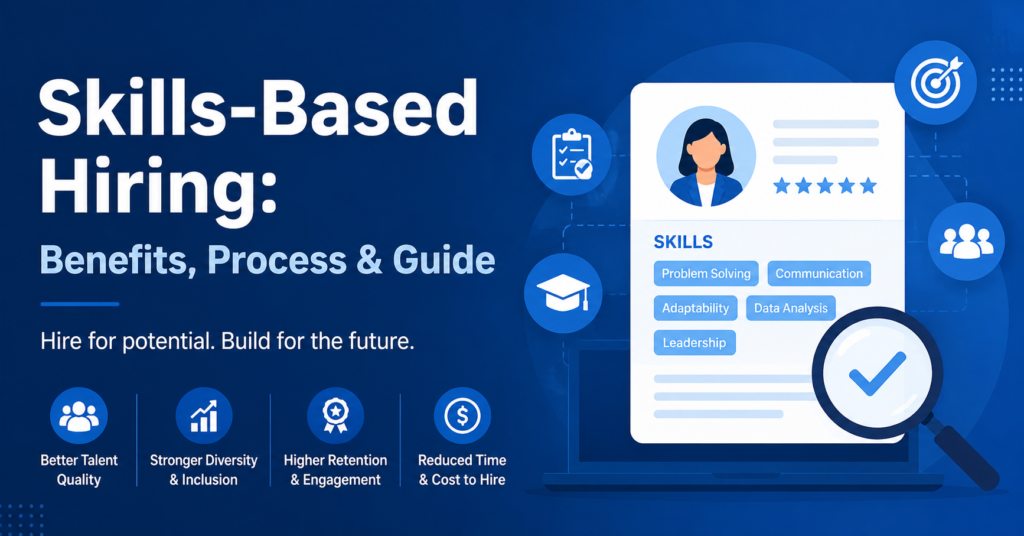
Skills-based hiring is becoming more important because things like job titles, degrees, and past experience no longer guarantee that someone will perform well in a job. Traditional hiring methods that focus only on these factors are struggling to keep up with how fast industries and required skills are changing.
Today, companies are focusing more on what a person can actually do rather than what is written on their resume. This approach helps businesses make better hiring decisions, find more talented candidates, and match the right people with the right roles.
As companies expand their search for the best fit, many are turning towards global talent acquisition strategies to find skilled professionals regardless of their location.
In this blog, you will learn why skills-based hiring matters today and how organizations can use it in a practical way.
What is Skills-Based Hiring?
Skills-based hiring is a way of hiring where companies focus on a candidate’s actual skills and abilities instead of just looking at degrees, job titles, or years of experience. Employers design the hiring process around what a person needs to do in the job and how well they can do it.
This approach is based on three main things:
what skills are required, how strong those skills need to be, and what results are expected from the role. Instead of relying only on good communication or being a team player, companies use practical assessments to check real abilities, such as completing a task, solving a problem, or handling a real work scenario.
Skills-based hiring does not mean that degrees or experience have no value. It simply means that skills are given more importance, and candidates are judged based on what they can actually deliver.
Why Skills-Based Hiring is Important?
The importance of skills-based hiring is growing because traditional hiring methods are no longer sufficient in today’s dynamic work environment.
1. Rapidly Changing Job Requirements
Technology is evolving quickly, and many job roles are constantly changing. Degrees earned years ago may not reflect current industry needs. Skills-based hiring ensures that candidates have up-to-date and relevant skills.
2. Closing the Skills Gap
Many companies struggle to find qualified talent even when there are plenty of job seekers. This gap exists because candidates may not meet rigid degree requirements despite having the necessary skills. Skills-based hiring helps bridge this gap.
3. Expanding the Talent Pool
By removing educational filters, companies can access a much larger and more diverse group of candidates, including freelancers and contractors. This is particularly useful when deciding between Contract labor vs Employee models to fill specific skill gaps.
4. Improving Hiring Accuracy
When hiring decisions are based on actual performance in assessments, the chances of selecting the right candidate increase significantly.
5. Supporting Diversity and Inclusion
Degree-based hiring can exclude capable candidates. A skills-first approach gives everyone a fair chance and makes hiring more inclusive.
Skills-Based Hiring vs Traditional Hiring
Understanding the difference between skills-based hiring and traditional hiring is important if you want to see why so many companies are shifting their approach. Both methods aim to find the right candidate, but the way they evaluate talent is very different.
1. Focus of Evaluation
Traditional hiring mainly focuses on a candidate’s background. Recruiters look at degrees, college reputation, past job titles, and years of experience. The assumption is that if someone has worked in a similar role or studied a certain subject, they will perform well.
Skills-based hiring focuses on what a candidate can actually do. Instead of assuming capability, employers test it.
2. Screening Process
In traditional hiring, candidates are shortlisted based on keywords, qualifications, and experience. This often leads to good candidates being rejected just because they don’t meet strict criteria on paper.
In skills-based hiring, candidates may go through skill assessments or tasks early in the process. This helps identify talent that might otherwise be overlooked.
3. Accuracy of Hiring Decisions
Traditional hiring relies on indirect indicators of performance. Degrees and job titles do not always reflect actual ability, which can lead to mismatched hires.
Skills-based hiring improves accuracy because decisions are based on real performance data. Employers can see how candidates solve problems, complete tasks, and handle job-related situations before making a decision.
4. Talent Pool Size
Traditional hiring often limits the talent pool by requiring specific degrees or experience levels. This excludes many capable individuals, including self-taught professionals or those switching careers.
Skills-based hiring expands the talent pool. It allows companies to consider candidates from diverse backgrounds as long as they have the required skills. This increases the chances of finding the right fit.
5. Speed and Efficiency
Traditional hiring can be slow because it involves multiple rounds of resume screening and interviews without clear performance data.
Skills-based hiring can be faster and more efficient. With structured assessments, recruiters can quickly identify top candidates based on measurable results.
6. Long-Term Outcomes
Traditional hiring does not always guarantee long-term success. Many candidates who look strong on paper may struggle to perform once they start the job. This often leads to low productivity, poor job fit, and higher employee turnover.
Skills-based hiring improves long-term outcomes because candidates are selected based on their ability to handle real job responsibilities. This results in better performance, higher job satisfaction, and stronger retention.
7. Cost of Hiring Mistakes
Hiring the wrong candidate can be expensive. Traditional hiring increases this risk because decisions are based on assumptions rather than proof of skill.
Skills-based hiring reduces costly mistakes by validating a candidate’s abilities before hiring. This leads to better hiring decisions and saves time and resources in the long run.
Benefits of Skills-Based Hiring
Skills-based hiring helps organizations make smarter hiring decisions by focusing on real abilities instead of assumptions. Here are some benefits of skills-based hiring.
- Better Quality of Hires: When candidates are tested on actual tasks, employers get a clear picture of their capabilities. This leads to hiring people who can perform well from the start.
- Access to a Larger Talent Pool: Removing strict degree or experience requirements allows companies to reach more candidates. This includes self-taught professionals, freelancers, and people from non-traditional career paths.
- Improved Employee Performance: Employees hired based on skills are more likely to meet job expectations. This improves overall productivity and team performance.
- Lower Employee Turnover: When candidates are selected based on their ability to do the job, they are more likely to succeed and stay longer in the role. This reduces hiring and replacement costs.
- Faster Hiring Decisions: Skill assessments provide clear and measurable results, making it easier for recruiters to compare candidates and make quicker decisions.
- Better Role Fit: Skills-based hiring ensures that candidates are matched to roles based on their strengths. This leads to higher job satisfaction and better outcomes.
- Increased Business Productivity: Hiring the right talent directly impacts business performance. Skilled employees can deliver results faster and contribute more effectively.
- Cost Savings in the Long Run: Reducing hiring mistakes saves significant resources. For businesses hiring across borders, combining this approach with efficient Global Payroll Services ensures that the entire onboarding and management process is seamless and compliant.
How Can Organizations Successfully Implement Skills-Based Hiring Practices?
Moving to skills-based hiring requires a clear shift in how companies define roles, evaluate candidates, and make hiring decisions.
Here’s how organizations can implement it in a practical and effective way:
1. Redefine Job Requirements Around Skills
Start by rewriting job descriptions. Remove unnecessary degree requirements and focus on what the role actually demands. Clearly mention the tasks the candidate will handle and the skills needed to perform them.
2. Focus on Real Skills, Not Assumptions
Traditional hiring often assumes that a degree or past role equals capability. Skills-based hiring removes that assumption. Instead of guessing, companies should verify whether a candidate can perform the required tasks.
3. Use Practical Skill Assessments
One of the most important steps is testing candidates on real tasks. This can include:
- Assignments related to the job
- Case studies
- Work simulations
- Portfolio reviews
These methods help employers see how candidates think, solve problems, and complete tasks in real situations.
4. Improve Candidate Screening Process
Instead of filtering candidates only through resumes, introduce skill-based screening early in the process. This allows candidates from different backgrounds to prove their abilities.
5. Expand and Diversify Talent Search
When you remove strict requirements like specific degrees or companies, your talent pool automatically becomes larger. This helps organizations reach skilled individuals from different backgrounds, including those who are self-taught or switching careers.
6. Structure Interviews Around Skills
Interviews should focus on evaluating real abilities instead of general questions. Ask candidates to explain how they would handle specific situations or solve problems related to the role.
How Do You Identify the Right Skills Your Business Needs to Succeed?
Identifying the right skills is a structured process where you connect your business goals with the actual abilities needed to achieve them.
Here’s how you can do it in a clear and practical way:
1. Start with Clear Business Goals
Every hiring decision should be linked to a business objective. Think about what your company is trying to achieve in the next 6 to 12 months. It could be scaling operations, improving customer experience, or entering a new market.
Once goals are clear, you can identify what kind of skills are needed to support them.
2. Break Roles into Real Work Tasks
Instead of focusing on job titles, look at the actual work involved. List down the key tasks for each role.
For example, if the role involves managing campaigns, analyzing data, or handling clients, each of these tasks will require specific skills. This approach gives you clarity on what you truly need instead of relying on assumptions.
3. Conduct a Skills Gap Analysis
Take a close look at your current team. Identify what skills already exist and where the gaps are.
Ask questions like:
- What skills are missing?
- Where are teams struggling?
- Which areas need improvement?
This helps you decide whether to hire new talent or upskill existing employees.
4. Focus on Core Business Skills
Some skills are essential for almost every business. These include:
- Leadership and decision-making
- Financial understanding and planning
- Sales and marketing abilities
- Problem-solving and adaptability
At the same time, make sure you balance technical skills with soft skills like communication and teamwork.
5. Stay Updated with Industry Trends
Markets are changing fast, and skill requirements are changing with them. Keep track of what is happening in your industry.
For example, many businesses now need skills related to digital tools, data analysis, and automation.
7. Take Input from Managers and Teams
Team leaders understand the real challenges of the job. Their feedback can help you identify practical skill requirements that may not be obvious on paper. Regular discussions and performance reviews can reveal where improvements are needed.
8. Define Skill Levels Clearly
It is not enough to say you need a skill. You also need to define how strong that skill should be.
For example:
- Basic level for support roles
- Intermediate level for independent work
- Advanced level for leadership roles
This makes hiring and evaluation more accurate.
Final Thoughts
Skills-based hiring is changing the way companies find and select talent. Instead of relying only on degrees or past experience, it focuses on real skills and the ability to perform. This approach helps businesses hire better, reduce bias, and build stronger teams. It also gives more people a fair chance to prove their capabilities.
By clearly identifying the right skills and using practical assessments, organizations can improve hiring results and long-term performance.
Frequently Asked Questions
Is skills-based hiring suitable for all types of roles?
Yes, skills-based hiring can be applied to most roles, including technical, creative, and even leadership positions. It is important to identify the right skills and design proper assessments for each role.
Does skills-based hiring completely replace degrees and experience?
No, it does not eliminate them completely. Degrees and experience can still be considered, but they are not the main deciding factors. Skills and actual performance carry more weight.
What are the biggest challenges in implementing skills-based hiring?
Some common challenges include creating accurate skill assessments, training hiring teams, and changing traditional hiring mindsets within the organization.
How can candidates prepare for skills-based hiring processes?
Candidates should focus on building practical skills, working on real projects, and creating a strong portfolio that shows their abilities instead of only relying on resumes.
What tools are commonly used in skills-based hiring?
Companies use various tools such as online assessment platforms, coding tests, project-based assignments, and interview frameworks to evaluate candidate skills effectively.