
Managing finances is one of the most important responsibilities for any business. From tracking daily transactions and preparing financial reports to ensuring tax compliance and accounting plays a critical role in business success. However, maintaining an in-house accounting team can be expensive and time-consuming, especially for startups and small to mid-sized businesses.
This is where outsourced accounting comes in. Instead of hiring and managing a full internal accounting department, businesses can partner with experienced accounting professionals who handle financial operations remotely. Many businesses that already use a virtual bookkeeper eventually expand to full outsourced accounting support as their financial needs become more complex.
In this guide, you’ll learn what outsourced accounting is, how it works, its benefits, challenges, and how to determine whether it’s the right solution for your business.
What Is Outsourced Accounting?
Outsourced accounting is a practice where a company partners with an external accounting firm or financial professionals to manage its accounting and financial operations instead of relying entirely on an in-house team. These experts function as an extension of the business, handling essential tasks such as bookkeeping, payroll, accounts payable and receivable, financial reporting, tax compliance, and budgeting.
Depending on business needs, outsourced accounting services can also include strategic financial planning and advisory support. This approach allows companies to access professional expertise, improve financial accuracy, reduce operational costs, and focus more on growth while ensuring their finances remain well-managed.
How Outsourced Accounting Works?
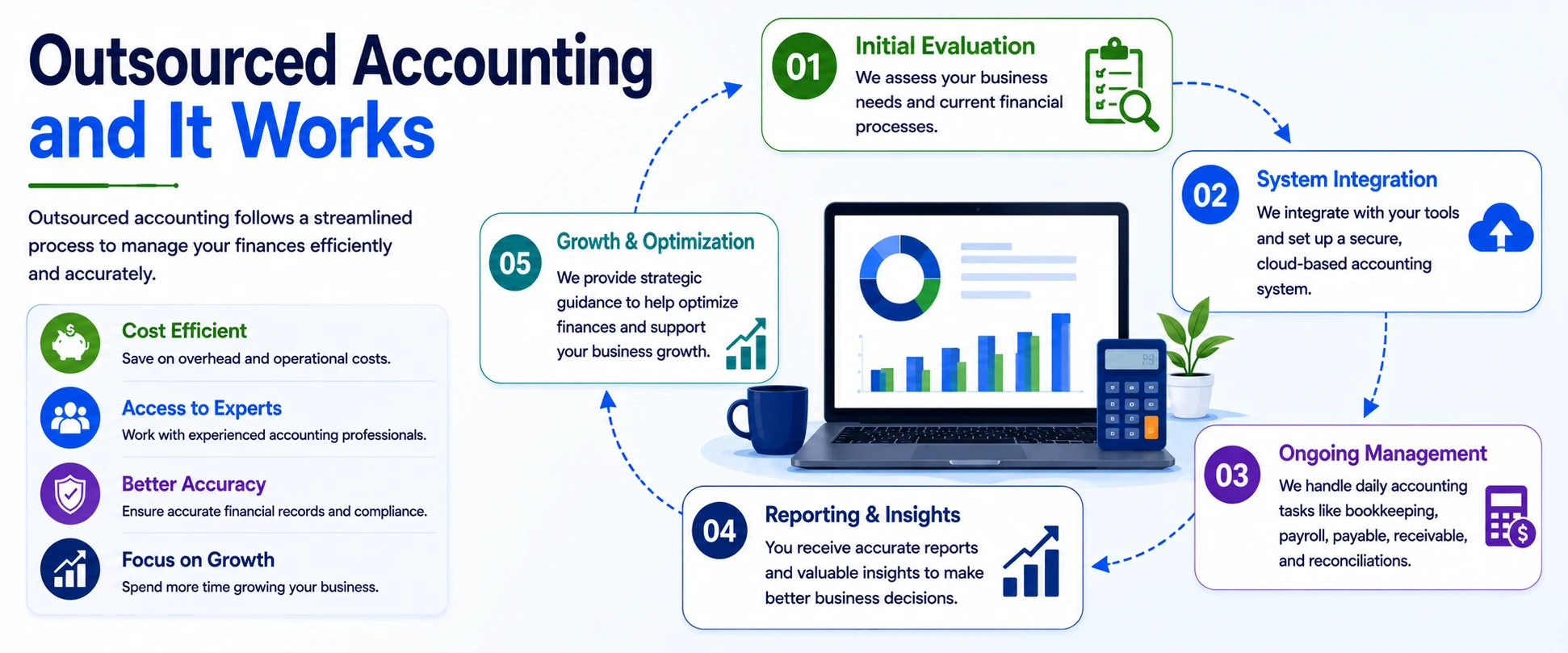
The outsourced accounting process typically begins with an assessment of a company’s financial needs and existing accounting processes.
1. Initial Evaluation
The accounting provider reviews the company’s current financial systems, transaction volume, reporting requirements, and compliance obligations. This helps determine which services are needed and how the partnership should be structured.
2. System Integration
Most outsourced accounting firms work with cloud-based accounting platforms such as QuickBooks, Xero, NetSuite, and Sage. A modern outsourced accounting system allows businesses to securely manage financial data, automate routine processes, and access real-time financial information from anywhere.
3. Ongoing Financial Management
Once systems are established, the outsourced team manages day-to-day accounting activities. These may include:
- Recording financial transactions
- Managing invoices and payments
- Reconciling bank accounts
- Processing payroll
- Preparing financial reports
- Monitoring cash flow
4. Reporting and Advisory Support
Regular reports provide business owners with valuable insights into company performance. In many cases, the outsourced accountant also offers strategic guidance to help improve profitability and support better decision-making.
Why Businesses Choose Outsourced Accounting?
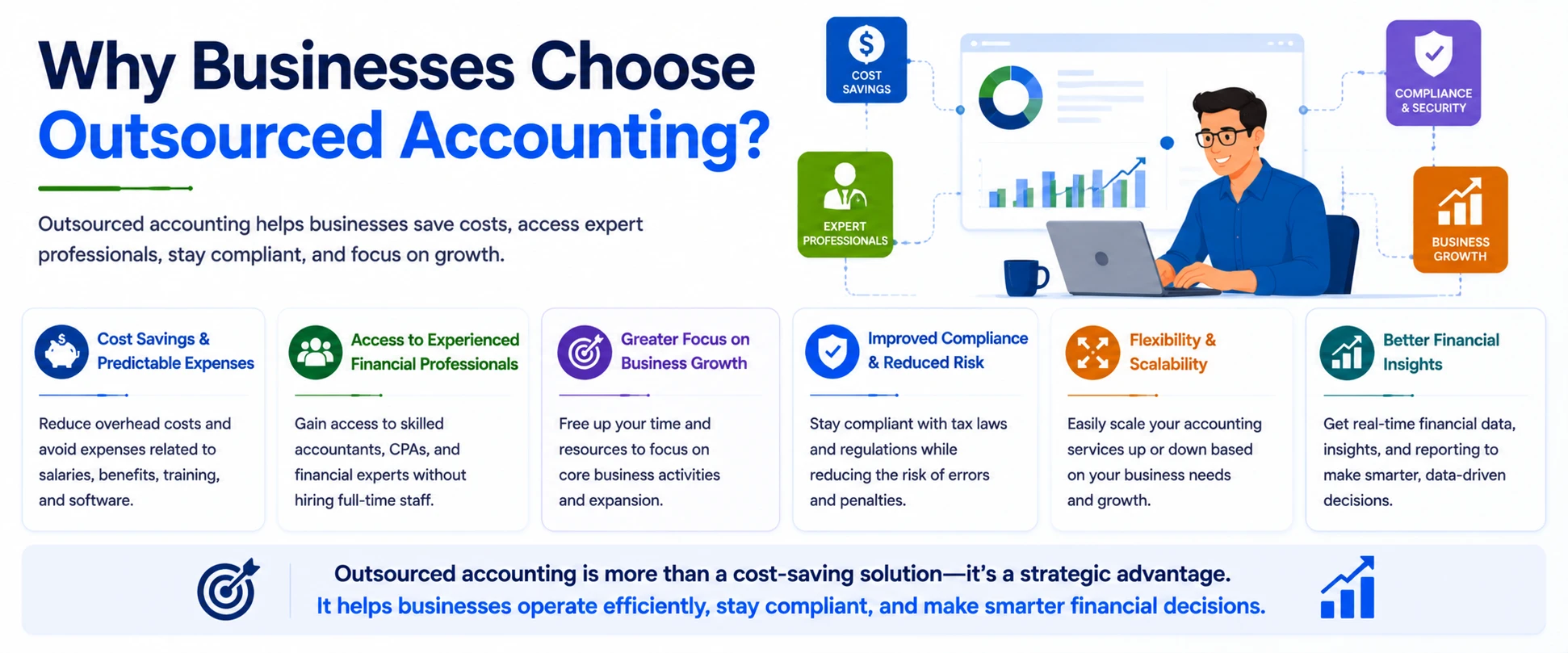
Businesses increasingly turn to outsourced accounting because it offers a combination of cost savings, expertise, and operational efficiency.
-
Cost Savings and Predictable Expenses
Outsourced accounting helps businesses avoid the significant costs associated with hiring and maintaining an in-house accounting team. Instead of paying salaries, employee benefits, recruitment expenses, and training costs, companies can access professional accounting support through predictable monthly service fees. It also reduces the need to invest in expensive accounting software and infrastructure.
-
Access to Experienced Financial Professionals
By outsourcing accounting functions, businesses gain access to skilled accountants, CPAs, financial advisors, and CFO-level expertise without the expense of hiring multiple full-time specialists. This ensures high-quality financial management and informed decision-making.
-
Greater Focus on Business Growth
Managing day-to-day accounting tasks can consume valuable time and resources. Outsourced accounting allows business owners and internal teams to spend less time on administrative financial work and focus more on strategic priorities such as sales, customer acquisition, product development, and expansion.
-
Improved Compliance and Reduced Risk
Professional accounting providers stay current with changing tax regulations, accounting standards, and compliance requirements. Their expertise helps minimize reporting errors, reduce the risk of penalties, and maintain accurate financial records.
-
Flexibility and Scalability
As business needs change, outsourced accounting services can easily scale up or down. Whether a company is experiencing rapid growth, seasonal fluctuations, or expanding into new markets, the level of support can be adjusted accordingly.
-
Better Financial Insights
Many outsourced accounting providers use advanced technology and reporting tools to deliver real-time financial data, cash flow analysis, profitability tracking, and forecasting. These insights help business owners make more informed and strategic decisions.
Services Included in Outsourced Accounting
One of the biggest advantages of outsourced accounting services is flexibility. Whether a company requires basic bookkeeping support or a complete outsourced accounting system, businesses can outsource specific accounting functions or their entire finance department.
Below are the top services included in outsourced accounting.
1. Bookkeeping Services
Bookkeeping forms the foundation of accurate financial management. It involves recording and organizing financial transactions, maintaining ledgers, and ensuring all financial data remains up to date.
2. Accounts Payable Management
This service helps businesses manage vendor invoices, payment schedules, expense approvals, and supplier relationships while maintaining healthy cash flow.
3. Accounts Receivable Management
Outsourced accounting providers can create invoices, track customer payments, follow up on overdue accounts, and improve collections processes.
4. Payroll Processing
Payroll administration can be complex and time-consuming. Outsourced providers manage employee salaries, tax withholdings, benefits deductions, and payroll compliance. Businesses with distributed teams often combine outsourced accounting with global payroll services to simplify payroll management.
5. Financial Reporting
Regular financial reporting provides visibility into business performance. Common reports include:
- Profit and loss statements
- Balance sheets
- Cash flow statements
- Budget variance reports
6. Tax Preparation and Compliance
Tax compliance is a critical aspect of business operations. Outsourced accounting firms help prepare tax filings, maintain compliance with regulations, and reduce the risk of penalties.
7. CFO and Financial Advisory Services
Some providers offer advanced services such as:
- Budgeting
- Forecasting
- Cash flow planning
- Financial strategy
- Business performance analysis
These services provide leadership-level financial guidance without the cost of hiring a full-time Chief Financial Officer.
Key Benefits of Outsourced Accounting
Businesses that implement outsourced accounting often experience both financial and operational improvements. Here are the primary benefits.
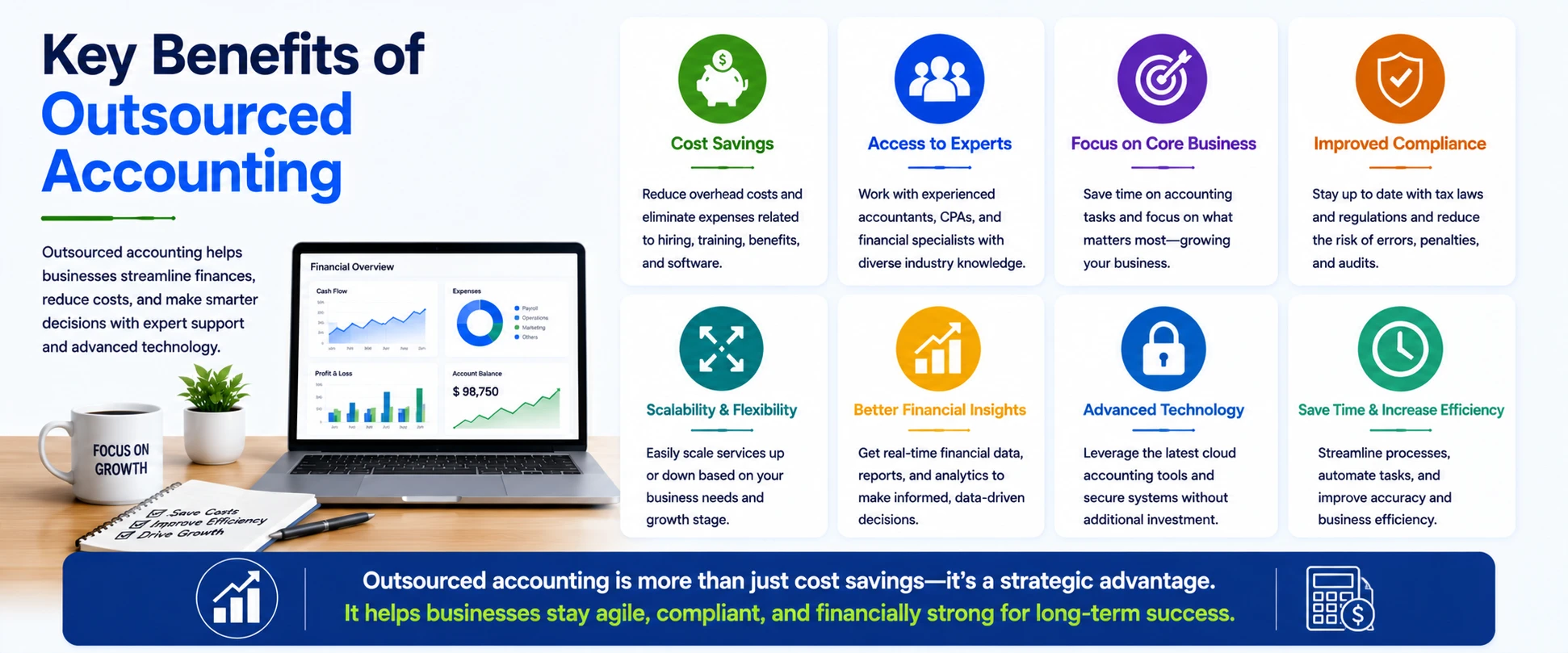
- Cost Savings: Businesses can reduce expenses related to hiring, training, employee benefits, and accounting software by paying only for the services they need.
- Access to Modern Technology: Outsourced accounting providers use advanced cloud-based tools and automation software, giving businesses access to the latest technology without additional investment.
- Scalability: Accounting support can easily increase or decrease based on business growth, seasonal demand, or changing financial requirements.
- Improved Financial Accuracy: Experienced professionals follow standardized processes that help reduce errors and maintain accurate financial records.
- Better Compliance Management: Accounting experts stay updated on tax laws and regulations, helping businesses remain compliant and avoid costly penalties.
- Real-Time Financial Insights: Regular reports and dashboards provide up-to-date information on financial performance, cash flow, and profitability.
- Time Savings: Outsourcing routine accounting tasks reduces administrative workload, allowing business owners and teams to focus on core business activities.
- Better Decision-Making: Access to accurate financial data and expert guidance helps business leaders make informed strategic and operational decisions.
- Enhanced Security: Reputable accounting firms implement strong security measures, including data encryption, secure cloud storage, and controlled access to financial information.
Potential Challenges of Outsourced Accounting
Although outsourced accounting offers numerous benefits, businesses should also understand potential challenges.
-
Communication Issues
Working with an external provider may occasionally create communication delays if expectations and processes are not clearly defined. Regular meetings and transparent communication channels help prevent misunderstandings.
-
Data Security Concerns
Sharing financial information with a third party requires trust. Businesses should evaluate security practices carefully before selecting a provider.
-
Reduced Direct Oversight
Some business owners may feel less control over accounting functions when they are handled externally. Choosing a provider that offers transparent reporting and regular updates can help maintain visibility.
-
Integration Challenges
Transitioning from an internal system to an outsourced accounting model may require process adjustments and technology integration. Proper planning and onboarding significantly reduce disruption during the transition.
-
Choosing the Wrong Provider
Not all accounting firms offer the same level of expertise or service quality. Selecting an inexperienced provider can create operational challenges and financial risks.
Is Outsourced Accounting Right for Your Business?
Outsourced accounting can be an excellent solution for many businesses, but it is important to evaluate your specific needs.
You may benefit from outsourced accounting if:
- Financial reports are frequently delayed
- Accounting costs continue to rise
- Your business is growing rapidly
- Tax compliance has become more complex
- Internal resources are limited
- You need better financial visibility
- Hiring a full accounting team is not financially practical
Startups and small businesses often find outsourced accounting particularly valuable because it provides professional expertise without requiring large financial investments.
Larger organizations may also use outsourced accounting to supplement internal teams or gain access to specialized financial skills.
How to Choose the Right Outsourced Accounting Provider?
Selecting the right provider is one of the most important decisions in the outsourcing process.
1. Evaluate Industry Experience
Look for providers with experience serving businesses similar to yours. Industry-specific knowledge can improve efficiency and compliance.
2. Assess Qualifications
Review professional certifications, credentials, and team expertise. Qualified accountants should have strong backgrounds in accounting, taxation, and financial reporting.
3. Review Technology Capabilities
Ensure the provider uses reliable cloud accounting software and secure data management systems.
4. Examine Security Standards
Ask about cybersecurity measures, data encryption, access controls, and backup procedures.
5. Check Client Reviews
Client testimonials, case studies, and references provide valuable insight into service quality and reliability.
6. Understand Communication Processes
Choose a provider that offers clear communication channels, dedicated points of contact, and regular reporting schedules.
7. Analyze Pricing
Compare pricing structures carefully and understand exactly what services are included. The cheapest option may not always provide the best value, so focus on both cost and service quality.
8. Define Communication and SLAs
Establish clear communication expectations and Service Level Agreements (SLAs) before starting the partnership. This should include reporting timelines, response times, meeting schedules, and performance standards.
9. Consider Scalability
Your accounting needs may evolve over time. The right provider should be capable of supporting future growth without requiring a major transition.
Final Thoughts
Managing business finances can quickly become challenging as a company grows. Outsourced accounting offers a practical way to stay on top of your finances without the expense and complexity of building a full in-house accounting team. It gives you access to experienced professionals, accurate financial reporting, and the flexibility to scale support as your business evolves.
More importantly, it allows you to spend less time worrying about accounting tasks and more time focusing on customers, growth, and long-term goals. If you’re looking for a smarter and more efficient way to manage your finances, outsourced accounting is worth considering.
Frequently Asked Questions
What Are the Different Types of Outsourcing?
The four main types of outsourcing are onshore, nearshore, offshore, and onsite outsourcing. Businesses choose these models based on cost, location, and operational requirements.
How Does Outsourced Accounting Work?
Outsourced accounting involves hiring an external accounting team to manage tasks such as bookkeeping, payroll, financial reporting, and tax compliance using secure cloud-based systems.
Is Outsourced Accounting Safe?
Yes. Reputable accounting providers use data encryption, secure cloud platforms, access controls, and other security measures to protect financial information.
How Much Does Outsourced Accounting Cost?
Costs vary depending on business size, transaction volume, and service requirements. Most businesses find outsourced accounting more cost-effective than maintaining a full in-house team.
Is Outsourced Accounting Right for Small Businesses?
Yes. Outsourced accounting helps small businesses access professional financial expertise, reduce costs, and focus more on growth without hiring a full accounting department.