
Today, companies are under constant pressure to hire faster without increasing recruitment costs. Some months require aggressive hiring, while others may need little to no recruitment support. Hiring teams often struggle with sudden talent demands, niche role hiring, and tight deadlines.
To solve this challenge, many organizations are now shifting toward On-Demand RPO, a flexible recruitment outsourcing model. Instead of maintaining a large in-house recruitment team all year, companies can access experienced recruiters, sourcing experts, and scalable hiring solutions based on current hiring needs.
Many organizations also combine On-Demand RPO with global talent acquisition strategies to improve hiring flexibility and access wider talent pools across different regions.
In this guide, you will learn how the model works, its benefits, challenges, and why it is becoming a preferred hiring solution.
What is On-Demand RPO?
On-Demand RPO, also known as On-Demand Recruitment Process Outsourcing, is a flexible hiring model where businesses outsource recruitment support based on immediate or short-term hiring needs.
On-Demand RPO allows companies to use recruitment services only when required. Businesses can quickly scale recruitment teams up or down depending on hiring demand.
How On-Demand RPO Works?
On-Demand RPO helps businesses scale recruitment support based on changing hiring needs without long-term commitments. Below are the key stages involved in the On-Demand RPO process.
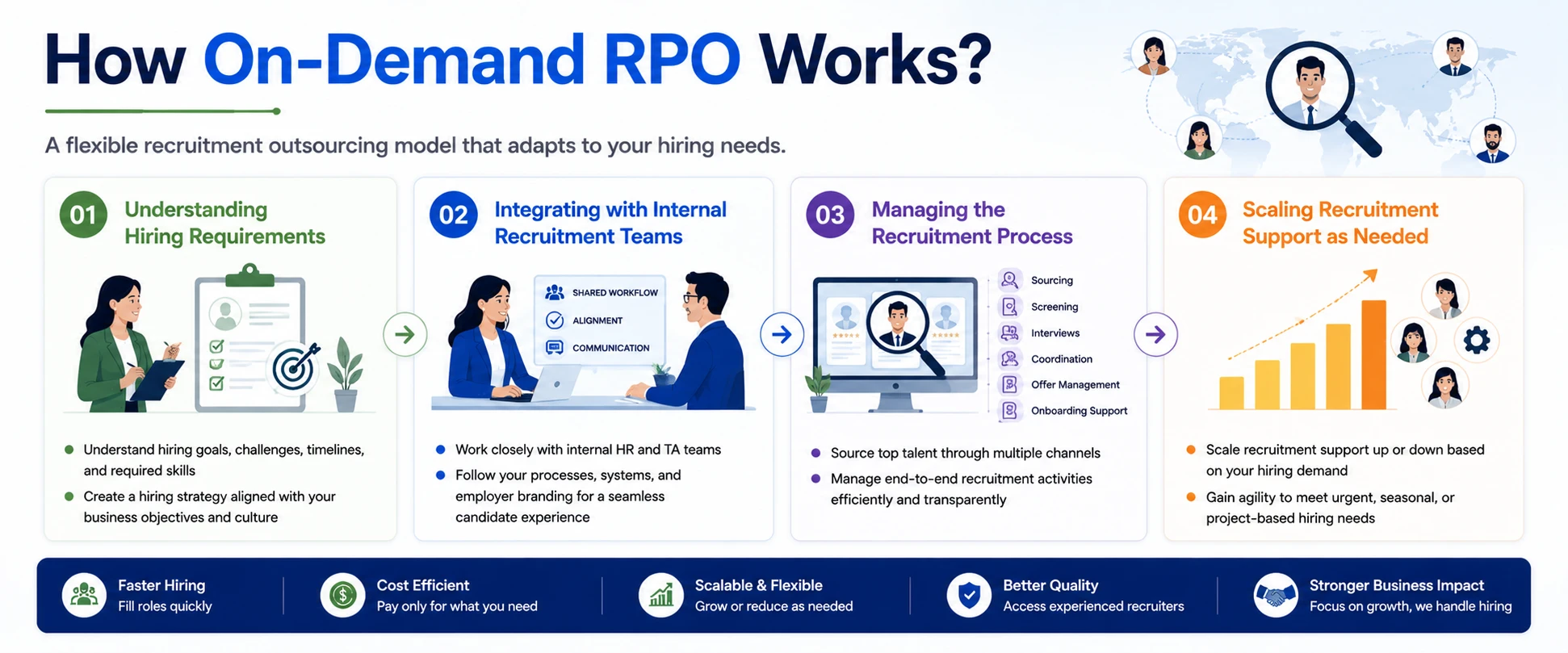
1. Understanding Hiring Requirements
The process usually starts with understanding the company’s immediate hiring goals, recruitment challenges, timelines, and required skill sets. This helps create a hiring strategy that matches business objectives, team structure, and company culture.
Companies with a strong talent acquisition strategy are usually able to align recruitment goals more effectively with long-term business growth.
2. Integrating with Internal Recruitment Teams
On-Demand RPO recruiters work closely with the internal HR or talent acquisition team. They follow the company’s recruitment process, communication style, and employer branding guidelines so the hiring experience stays consistent for candidates.
In many cases, recruiters also work within the company’s existing hiring systems and workflows, making collaboration smoother and more efficient.
3. Managing the Recruitment Process
Once the hiring plan is finalized, the recruitment team starts sourcing candidates through multiple channels such as job portals, professional networks, referrals, and passive talent outreach.
Depending on business needs, the team may support:
- Candidate sourcing
- Resume screening
- Initial interviews
- Interview coordination
- Offer management
- Candidate engagement
- Onboarding support
This flexible approach helps companies fill positions faster while reducing pressure on internal recruitment teams.
4. Scaling Recruitment Support as Needed
One of the biggest advantages of On-Demand RPO is scalability. Businesses can quickly increase recruitment support during expansion phases, seasonal hiring, or urgent hiring projects and reduce that support once hiring demand slows down.
Core Features of On-Demand RPO
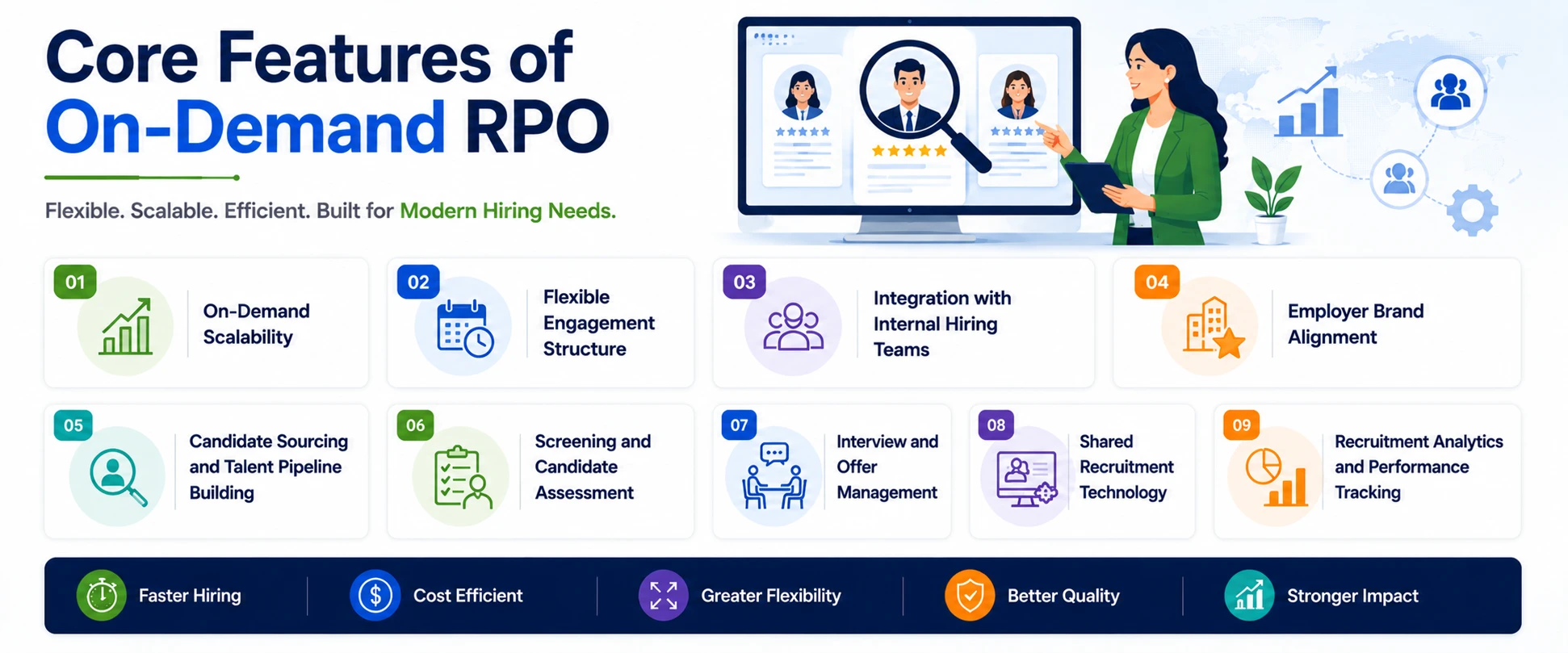
An On-Demand RPO model acts as a flexible extension of your internal HR team to handle sudden hiring spikes efficiently. Here are the core features that make this model so effective:
1. On-Demand Scalability
Some businesses suddenly need to hire aggressively during expansion phases, while others face seasonal spikes or project-based recruitment pressure. On-Demand RPO makes it easier to increase recruitment support during these periods and reduce it once hiring demand slows down.
2. Flexible Engagement Structure
Traditional recruitment process outsourcing models often work on long contracts, which may not suit businesses with fluctuating hiring needs. On-Demand RPO follows a much more flexible approach. Companies can use recruitment support for a few weeks, months, or specific hiring projects, depending on business requirements.
3. Integration with Internal Hiring Teams
One reason many companies prefer flexible RPO models is because recruiters work closely with internal HR teams instead of functioning like an external staffing agency.
The recruiters usually follow the company’s existing hiring workflows, communication standards, and recruitment processes. They also adapt to the organization’s work culture and employer branding approach, which creates a smoother experience for both candidates and hiring managers.
4. Employer Brand Alignment
In an On-Demand RPO model, recruiters represent the company directly during the hiring process, so maintaining employer brand consistency becomes essential.
From writing job descriptions to communicating with candidates, the recruitment process reflects the company’s culture, values, and professional image. This helps businesses build stronger relationships with potential hires and improves overall candidate engagement.
5. Candidate Sourcing and Talent Pipeline Building
A major part of On-Demand recruitment solutions involves proactive candidate sourcing. Recruiters actively search for suitable candidates through job platforms, professional networks, referrals, and passive talent outreach strategies. At the same time, recruiters also focus on building long-term talent pipelines.
6. Screening and Candidate Assessment
Before profiles reach hiring managers, recruiters handle the initial stages of candidate evaluation. This generally includes resume reviews, preliminary discussions, and basic skill assessments to identify candidates who genuinely match the role requirements.
7. Interview and Offer Management
On-Demand RPO providers often support the complete interview coordination process as well. This includes scheduling interviews, managing candidate communication, collecting feedback, and helping with offer discussions.
Some businesses also use recruitment support during onboarding to ensure a smoother transition after hiring decisions are finalized.
8. Shared Recruitment Technology
Modern recruitment outsourcing companies usually work alongside the organization’s existing hiring systems and recruitment tools. This may include Applicant Tracking Systems (ATS), Candidate Relationship Management platforms, sourcing software, and recruitment automation tools.
9. Recruitment Analytics and Performance Tracking
Data-driven hiring is another important feature of On-Demand RPO. Recruitment performance is continuously monitored to identify gaps and improve hiring efficiency over time.
Businesses can track metrics such as time-to-hire, cost-per-hire, candidate quality, and sourcing performance to better understand how their recruitment process is performing and where improvements are needed.
How On-Demand RPO Differs from Traditional RPO?
Although both models involve recruitment outsourcing, they operate very differently.
| Feature | Traditional RPO | On-Demand RPO |
| Contract Length | Long-term | Short-term or flexible |
| Hiring Support | Continuous | As-needed |
| Scalability | Limited | Highly scalable |
| Cost Structure | Fixed contracts | Pay-as-needed |
| Best For | Large enterprises | Growing and agile businesses |
Traditional RPO is usually designed for companies with ongoing, stable hiring requirements. On-Demand RPO, on the other hand, is built for flexibility.
For example, if a company suddenly needs to hire 100 employees in two months, an On-Demand RPO model can immediately provide recruitment support without long-term commitments. This flexibility makes it a strong option for businesses operating in fast-changing markets.
Why Businesses are Choosing On-Demand RPO?
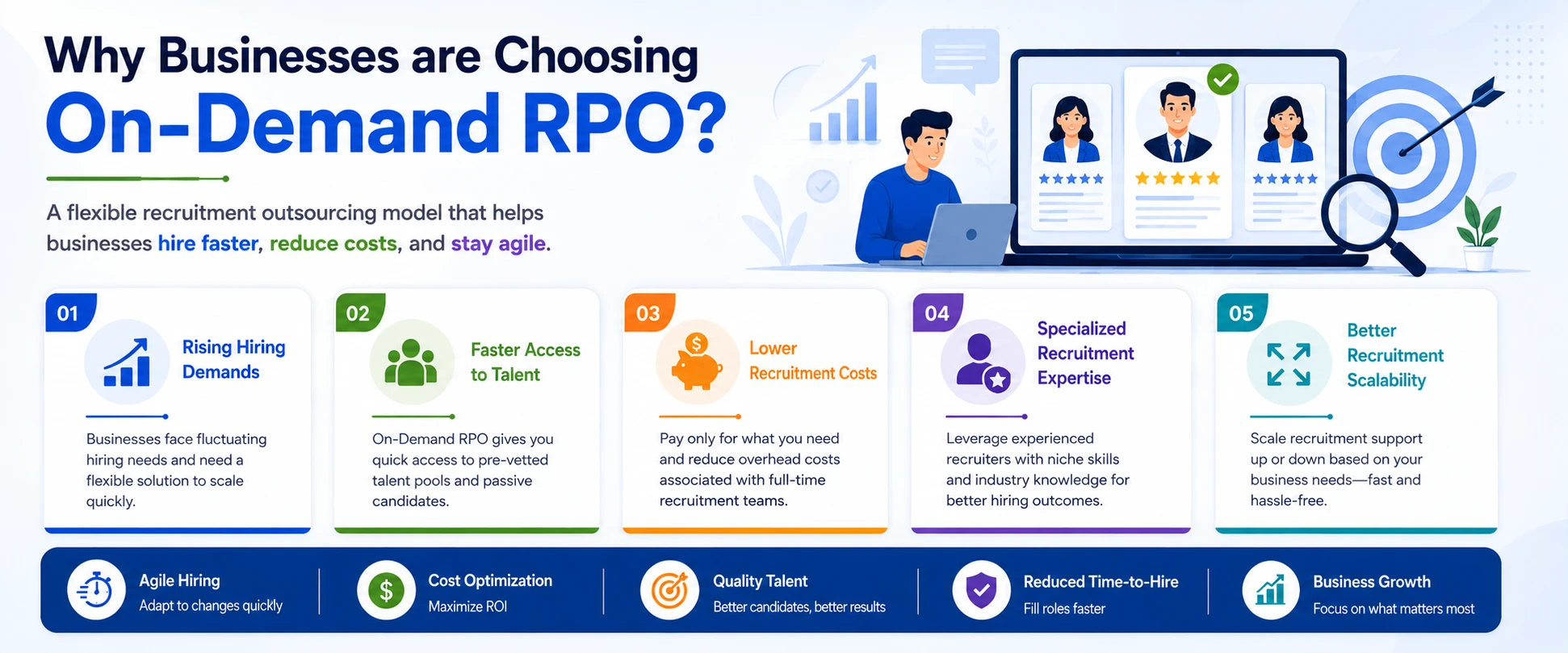
Modern hiring challenges are pushing companies toward more agile recruitment models. Here are some major reasons for choosing on-demand RPO.
1. Rising Hiring Demands
Businesses often experience unpredictable hiring spikes. Building a permanent internal recruitment team for temporary hiring needs is expensive. On-Demand recruitment solutions solve this problem by providing recruiters only when needed.
2. Faster Access to Talent
Hiring delays can affect business growth. On-Demand RPO providers already have established talent networks and sourcing systems, helping companies fill positions faster.
3. Lower Recruitment Costs
Maintaining internal recruiters, recruitment software, job board subscriptions, and hiring infrastructure can become costly. Flexible RPO models help businesses reduce these operational expenses.
4. Specialized Recruitment Expertise
Certain industries face severe talent shortages. Technical hiring, healthcare recruitment, and executive hiring often require niche recruitment expertise. On-Demand RPO providers bring industry-specific knowledge and sourcing capabilities.
5. Better Recruitment Scalability
Businesses today need scalable hiring services that can adapt quickly to market conditions. On-Demand RPO makes it easier to:
- Scale hiring during expansion
- Reduce recruitment support during slow periods
- Handle project-based recruitment
Types of On-Demand RPO Services
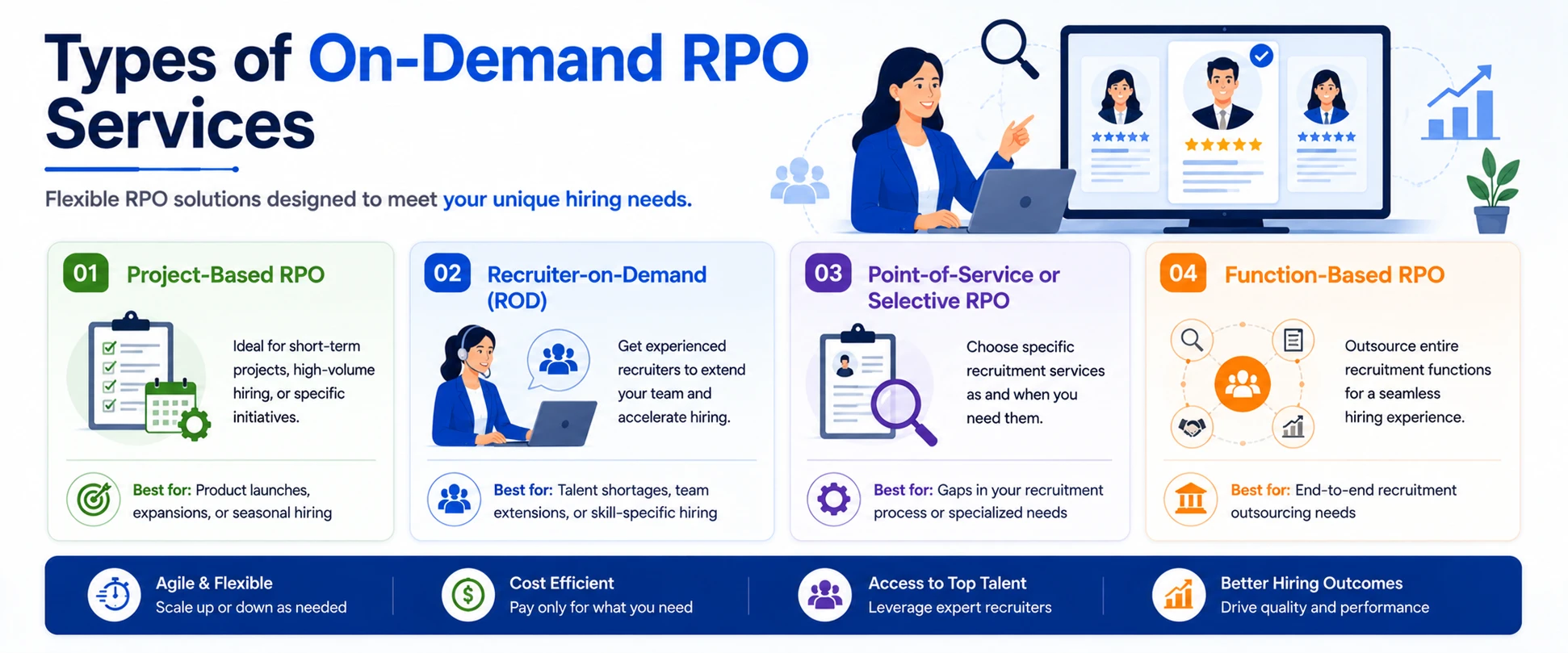
On-Demand RPO services are available in different models depending on a company’s hiring goals, recruitment volume, and internal HR capacity. Businesses can choose the level of recruitment support they need without committing to a fixed long-term structure.
1. Project-Based RPO
Project-Based RPO is used for temporary or high-volume hiring needs such as business expansion, seasonal recruitment, product launches, or opening new locations.
In this model, the recruitment team manages the hiring process for a specific project duration, including sourcing, screening, interview coordination, and onboarding support. It works well for companies that need to fill multiple roles quickly.
2. Recruiter-on-Demand (ROD)
Recruiter-on-Demand allows businesses to add experienced recruiters to their internal hiring team for a short period.
These recruiters work closely with the company’s HR department, follow internal hiring processes, and support urgent or specialized hiring needs. This model is commonly used when internal teams are overloaded or when businesses need niche recruitment expertise.
3. Point-of-Service or Selective RPO
Selective RPO focuses on outsourcing only specific stages of the recruitment process instead of the entire hiring cycle.
For example, companies may outsource candidate sourcing, resume screening, or interview scheduling while keeping final hiring decisions in-house. This model is ideal for businesses that need support in specific recruitment areas.
4. Function-Based RPO
Function-Based RPO handles recruitment for a specific department or business function rather than the whole organization.
Businesses often use this model for departments facing skill shortages or high hiring demand, such as engineering, sales, healthcare, or technology hiring. It helps improve recruitment quality through focused hiring expertise.
Benefits of On-Demand RPO
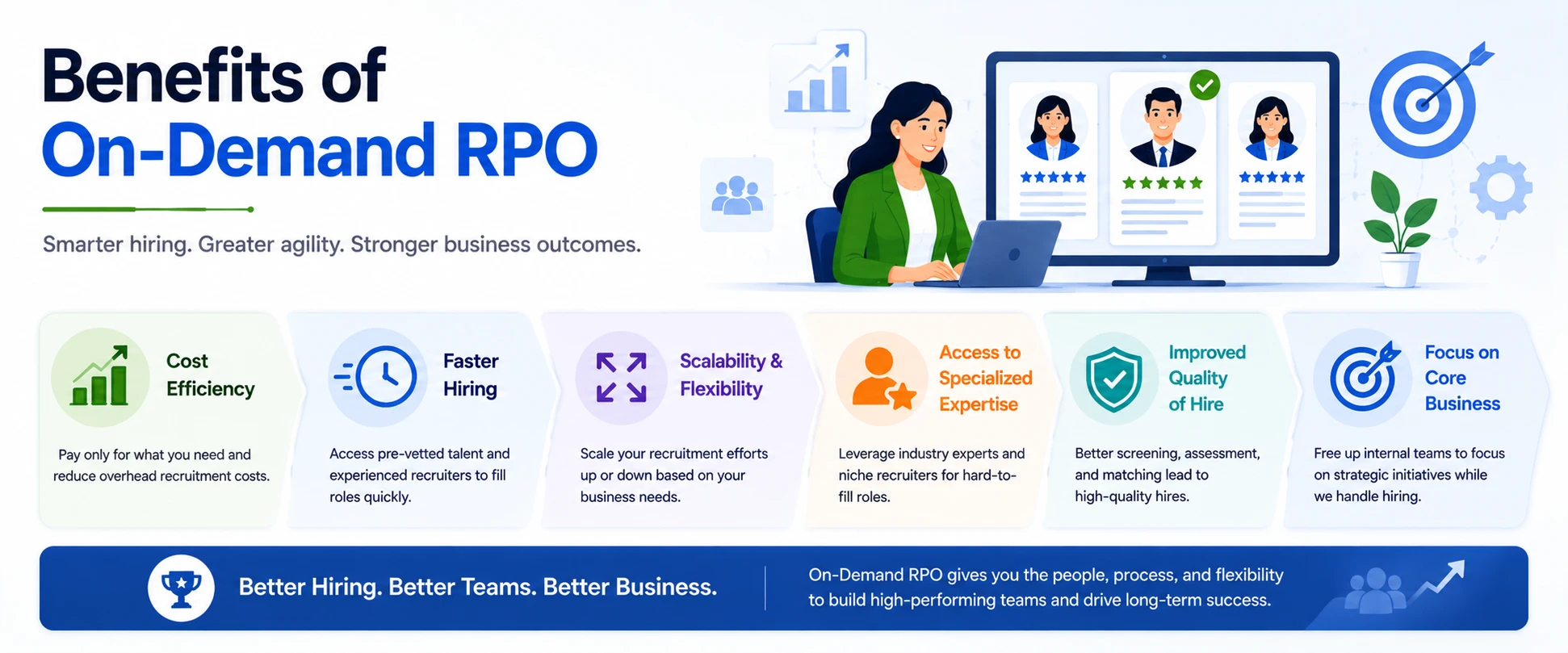
On-Demand RPO helps businesses manage recruitment more efficiently by offering flexible and scalable hiring support. Below are some key benefits of this flexible Recruitment Process Outsourcing model.
1. Faster Hiring Process
On-Demand RPO helps companies fill positions faster by using experienced recruiters, existing talent networks, and proven sourcing strategies. This is especially helpful during urgent hiring drives or high-volume recruitment periods.
2. Flexible Recruitment Support
Hiring demands often change throughout the year. On-Demand RPO allows businesses to increase or reduce recruitment support based on current hiring needs without long-term commitments.
3. Reduced Recruitment Costs
Maintaining a full in-house recruitment team can be expensive. With On-Demand recruitment solutions, businesses only pay for the hiring support they actually use, helping reduce overall recruitment costs.
4. Access to Specialized Recruiters
Many RPO recruitment services provide recruiters with expertise in technical, healthcare, executive, or niche hiring areas. This improves the chances of finding qualified candidates more quickly.
5. Better Candidate Experience
Recruiters work closely with internal teams and follow the company’s hiring process, which helps create smoother communication and a more professional candidate experience.
6. Reduced Workload for Internal HR Teams
During busy hiring periods, internal HR teams can become overloaded. On-Demand RPO handles sourcing, screening, and interview coordination, allowing HR teams to focus on other priorities.
7. Scalable Hiring Support
Businesses can quickly scale recruitment support during expansion, seasonal hiring, or project-based recruitment without increasing permanent HR headcount.
8. Access to Recruitment Technology and Analytics
Most recruitment outsourcing companies use modern hiring tools and analytics platforms to improve candidate tracking, hiring performance, and recruitment efficiency.
Challenges of On-Demand RPO
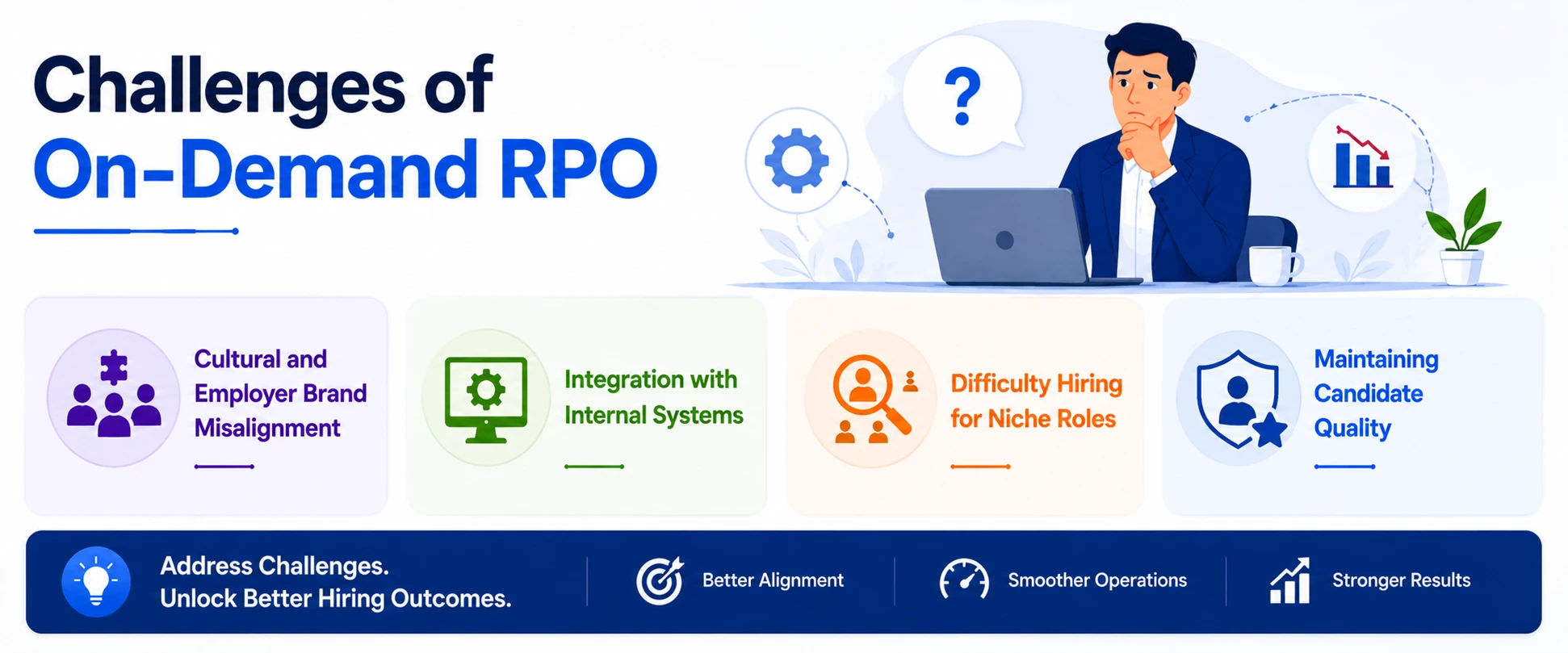
Although On-Demand RPO offers flexibility and scalable hiring support, it also comes with certain recruitment challenges. Below are some common issues businesses may face while using flexible RPO services.
-
Cultural and Employer Brand Misalignment
Since On-Demand RPO recruiters work externally and often join recruitment projects for a limited period, they may initially lack a deep understanding of the company’s culture and work environment.
This can sometimes affect candidate communication and employer branding consistency during the hiring process.
-
Integration with Internal Systems
For successful recruitment outsourcing, external recruiters must work smoothly with internal HR teams and existing hiring systems.
However, integration challenges can arise when:
- Recruitment workflows are unclear
- Hiring tools are not aligned
- Communication processes are inconsistent
These issues may create delays in candidate tracking, reporting, and overall recruitment coordination.
-
Difficulty Hiring for Niche Roles
On-Demand RPO works very well for high-volume hiring, but highly specialized roles can still be challenging.
Industries requiring technical expertise or niche talent often need recruiters with deep market knowledge and strong industry networks. Without long-term exposure to those specific hiring markets, finding qualified candidates may take more time.
-
Maintaining Candidate Quality
In fast-paced hiring projects, there can sometimes be pressure to fill positions quickly. If recruitment speed becomes the main priority, candidate quality and long-term cultural fit may be overlooked.
This is why businesses should establish clear hiring expectations, recruitment goals, and performance metrics from the beginning to maintain strong hiring standards.
Final Thoughts
On-Demand RPO gives businesses a flexible and scalable way to manage changing hiring needs without long-term recruitment commitments. Whether it is high-volume hiring, niche recruitment, or short-term hiring support, this model helps companies hire faster while controlling recruitment costs.
As hiring demands continue to evolve, more businesses are adopting On-Demand RPO to improve recruitment efficiency, access better talent, and stay competitive in today’s fast-moving job market.
Frequently Asked Questions
How does On-Demand RPO differ from a regular recruitment agency?
An agency works externally and charges a fee per hire. On-Demand RPO embeds recruiters directly into your team to work under your company brand, using your systems for a flexible project-based fee.
How long does an On-Demand RPO contract typically last?
Contracts are completely flexible and project-driven. They can last anywhere from a few weeks to several months.
Will On-Demand RPO replace my internal HR team?
No, it is built to support your team, not replace them. The embedded recruiters handle the heavy lifting of sourcing and screening, freeing up your internal HR to focus on final selections and core tasks.
Can it help with specialized or highly technical roles?
Yes. You can bring in specialized recruiters with deep industry networks specifically for niche departments like tech or sales, ensuring complex roles are filled quickly without long-term commitments.