Hiring in 2026 looks very different from what it did a few years ago. Companies are no longer competing only on salary packages. Candidates now evaluate workplace culture, flexibility, career growth, leadership transparency, and hiring experience before accepting an offer.
At the same time, businesses are facing talent shortages, faster digital transformation, and rising hiring costs. This is why organizations need a strong talent acquisition strategy instead of relying on traditional recruitment methods. A modern talent acquisition approach helps companies attract skilled professionals, improve hiring quality, reduce turnover, and build long-term workforce stability.
In this guide, you will learn a practical 7-step talent acquisition framework that businesses can use to build smarter and future-ready hiring systems in 2026.
What Is Talent Acquisition Strategy?
A talent acquisition strategy is a long-term approach used by organizations to identify, attract, hire, and retain skilled employees. Talent acquisition is connected directly to business growth and workforce planning.
The purpose of talent acquisition is not just hiring employees. It is about building a sustainable talent pipeline that supports future company goals.
A strong talent acquisition strategy includes:
- Workforce planning
- Employer branding
- Recruitment marketing
- Skills-based hiring
- Candidate experience
- Hiring analytics
- Employee retention planning
Difference Between Recruitment and Talent Acquisition
Recruitment and talent acquisition are often used interchangeably, but both have different purposes. Recruitment focuses on filling immediate job openings, while talent acquisition is a long-term strategy focused on future workforce planning, employer branding, and business growth.
Below are the key differences between recruitment and talent acquisition:
| Recruitment | Talent Acquisition |
| Focuses on immediate hiring needs | Focuses on long-term workforce planning |
| Reactive hiring process | Proactive hiring strategy |
| Designed to fill current vacancies | Builds future talent pipelines |
| Short-term approach | Continuous long-term process |
| Transactional hiring activity | Strategic business function |
| Common in high-volume hiring | Common for specialized and leadership hiring |
| Limited focus on branding | Strong focus on employer branding and candidate relationships |
Why Talent Acquisition Matters in 2026?
Talent acquisition has become a strategic business priority that helps companies manage skill shortages, adopt AI-driven hiring, improve retention, and build future-ready teams. Businesses that invest in strong talent acquisition strategies are better prepared for long-term growth and market competition.
Here are the major reasons why talent acquisition matters in 2026:
-
Growing Skills Gap
Many industries are facing shortages of skilled professionals, especially in AI, cybersecurity, cloud computing, and data analytics.
-
Rise of Skills-Based Hiring
Companies are prioritizing practical skills and competencies over degrees to access a wider talent pool.
-
AI Is Transforming Recruitment
AI tools are helping recruiters automate resume screening, candidate matching, interview scheduling, and hiring analytics.
-
Changing Candidate Expectations
Candidates now expect flexible work models, faster communication, career growth opportunities, and better hiring experiences. Organizations are now investing heavily in improving the candidate experience approach to attract and retain top talent.
-
Employer Branding Influences Hiring
A strong employer brand helps companies attract qualified candidates and improve employee retention.
-
Supports Long-Term Business Growth
Strategic talent acquisition helps businesses build resilient teams, strengthen leadership pipelines, and stay competitive in a rapidly evolving market.
The 7-Step Talent Acquisition Framework for 2026
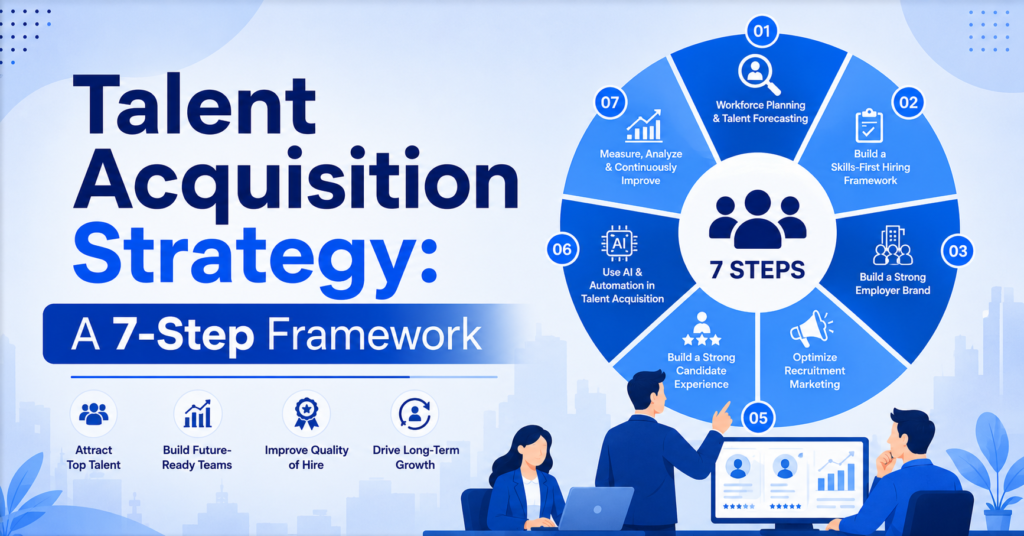
Companies now need a structured framework that combines workforce planning, skills-based hiring, employer branding, recruitment marketing, AI adoption, and hiring analytics.
Below is a practical 7-step talent acquisition framework that helps businesses attract, hire, and retain top talent more effectively.
Step 1: Workforce Planning and Talent Forecasting
Successful hiring starts with workforce planning. Companies should understand what talent they need today and what skills will be required in the future.
Workforce planning helps businesses avoid reactive hiring and reduce talent shortages.
Key areas of workforce planning include:
- Identifying future hiring needs
- Analyzing skill gaps
- Succession planning
- Department-wise hiring forecasts
- Business expansion planning
Talent forecasting also improves budgeting and hiring timelines. Businesses that plan early usually make better hiring decisions than companies that hire under pressure.
For companies hiring distributed teams across countries, integrating global talent acquisition strategies into workforce planning is becoming increasingly important.
Step 2: Build a Skills-First Hiring Framework
Instead of focusing only on degrees and job titles, companies now evaluate candidates based on practical abilities, problem-solving skills, adaptability, and real-world experience.
A skills-first hiring framework includes:
- Defining role-specific competencies
- Using skill assessments
- Conducting structured interviews
- Removing unnecessary degree requirements
- Evaluating practical performance
This approach expands the talent pool and improves workforce diversity. Skills-first hiring also reduces bias and helps businesses find high-performing candidates who may be overlooked in traditional hiring systems.
Step 3: Build a Strong Employer Brand
Candidates often research company culture, leadership, employee reviews, and workplace environment before applying.
A strong employer brand helps organizations attract better talent without depending heavily on expensive job advertising.
Key elements of employer branding include:
- Positive workplace culture
- Employee recognition
- Career growth opportunities
- Transparent leadership
- Diversity and inclusion initiatives
- Employee wellbeing programs
Companies can strengthen employer branding through:
- LinkedIn content
- Employee testimonials
- Career pages
- Social media engagement
- Behind-the-scenes workplace content
Candidates trust employee experiences more than promotional advertising. Businesses with strong employer brands usually receive more qualified applicants and higher employee retention.
Companies with remote and hybrid work models are also investing in virtual team-building activities to improve employee engagement, collaboration, and workplace culture.
Step 4: Optimize Recruitment Marketing
Recruitment marketing helps companies attract the right candidates using targeted hiring campaigns and content-driven strategies.
Modern recruitment marketing includes:
- Writing SEO-friendly job descriptions
- Using LinkedIn and social media hiring campaigns
- Building talent communities
- Creating employee-generated content
- Running targeted recruitment ads
An effective recruitment marketing strategy improves candidate quality and increases hiring visibility in competitive industries.
Step 5: Build A Strong Candidate Experience
A slow or poorly managed recruitment process can damage an employer’s reputation and cause companies to lose top candidates.
Companies can improve candidate experience by:
- Simplifying job applications
- Providing faster communication
- Conducting structured interviews
- Sharing transparent hiring updates
- Giving interview feedback on time
A positive hiring experience increases offer acceptance rates and strengthens employer branding.
Step 6: Use AI and Automation in Talent Acquisition
AI and automation are reshaping modern recruitment processes.
Recruiters now use AI-powered tools for:
- Resume screening
- Candidate matching
- Interview scheduling
- Recruitment chatbots
- Hiring analytics
- Talent sourcing
AI helps hiring teams save time and improve efficiency. Instead of manually reviewing thousands of resumes, recruiters can focus on relationship building and strategic hiring decisions.
However, companies should avoid over-dependence on automation.
Human judgment is still important for evaluating communication skills, cultural fit, emotional intelligence, and leadership potential. Businesses should use AI to support recruiters, not replace them completely.
Responsible AI usage also requires:
- Reducing algorithm bias
- Protecting candidate data
- Maintaining hiring transparency
- Conducting regular audits of AI systems
Step 7: Measure, Analyze, and Continuously Improve
A successful talent acquisition strategy should always be data-driven. Companies that track hiring metrics can identify weaknesses, improve hiring quality, and optimize recruitment spending. Important recruitment KPIs include:
- Time-to-Hire: Measures how quickly positions are filled.
- Cost-per-Hire: Tracks recruitment spending for each hire.
- Quality-of-Hire: Evaluates employee performance and long-term success.
- Offer Acceptance Rate: Measures how many candidates accept job offers.
- Employee Retention Rate: Shows how effectively companies retain talent.
- Source-of-Hire: Identifies which hiring channels generate the best candidates.
Regular hiring analysis helps businesses improve recruitment strategies continuously. Organizations should review hiring performance quarterly and adjust strategies based on data insights.
Common Talent Acquisition Mistakes to Avoid
Even companies with strong hiring budgets struggle to attract and retain top talent because of avoidable recruitment mistakes. Businesses need a strategic, data-driven, and candidate-focused approach to stay competitive.
Below are some of the most common talent acquisition mistakes companies should avoid.
1. Hiring Without Workforce Planning
Many businesses hire only when an employee leaves or the workload suddenly increases. This creates pressure on recruiters to close positions quickly, which often leads to poor hiring decisions.
Without workforce planning, companies struggle to identify future skill requirements and leadership gaps. As industries evolve rapidly, reactive hiring makes it difficult to stay competitive.
Businesses that invest in workforce planning can prepare for future expansion, reduce hiring delays, and build stronger teams over time.
2. Ignoring Employer Branding
Candidates evaluate work culture, employee reviews, leadership transparency, and growth opportunities. If a company has a weak online reputation or poor employee feedback, attracting skilled professionals becomes much harder.
Strong employer branding helps organizations stand out in competitive hiring markets. Companies that actively showcase their culture and employee experience usually attract more qualified applicants and improve retention.
3. Slow Hiring Process
A long and complicated hiring process is one of the fastest ways to lose top talent. Skilled candidates often receive multiple offers, and delays can push them toward competitors.
Many companies lose candidates because of unnecessary interview rounds, slow approvals, or poor coordination between recruiters and hiring managers. Reducing hiring delays not only improves candidate experience but also helps businesses secure better talent before competitors do.
4. Poor Candidate Communication
Candidates expect transparency during recruitment. When companies fail to provide updates, feedback, or clear timelines, it creates frustration and damages the employer’s reputation.
Even highly interested candidates may lose trust if communication becomes inconsistent.
Simple improvements like timely responses, interview updates, and professional communication can significantly improve candidate experience and strengthen employer branding.
5. Over-Reliance on Degrees
Relying too heavily on degrees can cause companies to overlook highly skilled professionals with strong practical experience. Many organizations are shifting toward skills-based hiring because real-world abilities matter more than qualifications alone in many industries.
Candidates with certifications, project experience, freelance work, or technical skills can often perform better than applicants chosen only because of academic credentials.
6. Not Tracking Recruitment Metrics
Many hiring teams make decisions based on assumptions instead of actual recruitment data. Without analytics, companies cannot understand what is working and what needs improvement.
Tracking hiring metrics helps businesses identify bottlenecks, improve recruitment efficiency, and reduce unnecessary hiring costs.
Metrics like time-to-hire, quality-of-hire, and employee retention provide valuable insights that help organizations optimize their talent acquisition strategy.
7. Depending Fully on AI
AI has become an important part of modern recruitment, but depending entirely on automation can create hiring risks.
AI tools can speed up resume screening and candidate matching, but technology cannot fully understand human qualities like emotional intelligence, communication style, leadership potential, or cultural fit.
The best hiring strategies combine AI efficiency with human judgment. Companies that maintain this balance usually create stronger hiring outcomes and better candidate relationships.
Final Thoughts
Talent acquisition in 2026 is no longer limited to posting jobs and conducting interviews. Companies now need a strategic and long-term hiring approach that combines workforce planning, employer branding, recruitment marketing, candidate experience, AI adoption, and hiring analytics.
Businesses that invest in modern talent acquisition strategies will attract stronger candidates, improve employee retention, and build future-ready teams. The companies winning the talent race today are those creating faster, smarter, and more human-centered hiring experiences.
Instead of treating hiring as a reactive process, organizations should focus on building sustainable talent pipelines that support long-term growth.
Frequently Asked Questions
How does AI help in talent acquisition?
AI helps recruiters automate tasks like resume screening, interview scheduling, candidate matching, recruitment analytics, and talent sourcing, making the hiring process faster and more efficient.
What role does workforce planning play in talent acquisition?
Workforce planning helps companies predict future hiring needs, identify skill gaps, prepare succession plans, and align recruitment with long-term business growth.
How can small businesses improve talent acquisition?
Small businesses can improve talent acquisition by building a strong employer brand, using employee referrals, improving candidate communication, and adopting skills-based hiring strategies.
What are common talent acquisition mistakes companies make?
Some common mistakes include hiring without workforce planning, ignoring employer branding, slow hiring processes, poor candidate communication, and depending too heavily on AI.
How can companies improve candidate experience?
Businesses can improve candidate experience by simplifying applications, reducing hiring delays, communicating clearly, conducting structured interviews, and providing timely feedback.