Hiring today is more challenging than ever. Companies are struggling with talent shortages, rising recruitment costs, longer hiring cycles, and increasing pressure to scale quickly. Traditional hiring models often fail to provide the flexibility businesses need, especially during rapid growth or project-based expansion. That is why many organizations are shifting toward Recruiter on Demand services.
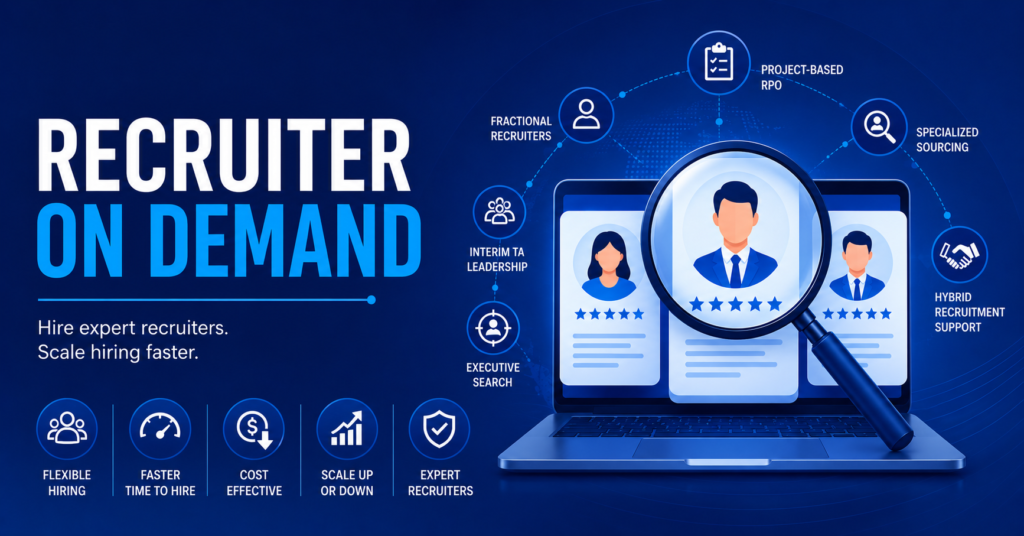
Recruiter on Demand gives businesses flexible access to experienced recruiters without the long-term cost of maintaining a full internal recruitment team. Whether a company needs technical recruiters for urgent hiring, support during seasonal growth, or scalable recruitment solutions for expansion, this model offers speed, flexibility, and efficiency.
In this guide, you will learn how Recruiter on Demand works, its benefits, service types, challenges, and how businesses can use it to improve hiring outcomes.
What Is Recruiter on Demand?
Recruiter on Demand is a flexible recruitment model where companies hire recruiters as needed instead of maintaining a large in-house recruitment team or relying completely on traditional recruitment agencies.
Under this model, businesses can access experienced recruiters for a specific duration, project, hiring campaign, or business requirement.
Unlike conventional agencies that charge high placement fees, Recruiter on Demand works as an extension of a company’s hiring team. Recruiters manage sourcing, screening, coordination, and hiring support based on business requirements.
This model is becoming popular among startups, fast-growing companies, enterprises, and organizations handling project-based hiring. Businesses expanding internationally are also integrating global talent acquisition strategies with recruiter on demand models to access wider talent pools faster.
How Recruiter on Demand Works?
The Recruiter on Demand process is designed to provide scalable hiring support quickly and efficiently.
The process usually starts with understanding the company’s hiring goals, role requirements, timelines, and budget. Once requirements are finalized, recruiters are assigned based on expertise and industry experience.
The recruiter then handles key recruitment tasks, including:
- Candidate sourcing
- Resume screening
- Talent outreach
- Interview coordination
- Candidate communication
- Offer support
- Hiring pipeline management
Businesses can hire recruiters for short-term, long-term, or project-based requirements. Some companies use this model during expansion phases, while others use it only when hiring demand increases.
The biggest advantage is flexibility. Organizations can scale recruiting efforts up or down without hiring permanent internal recruiters.
Read more: Skills-Based Hiring: A Practical Guide for Employers
Types of Recruiter on Demand Services
Recruiter on Demand (ROD) services help businesses manage hiring needs with greater flexibility and lower costs. Instead of hiring full-time recruiters, companies can access experienced recruitment professionals for specific projects, temporary hiring needs, or ongoing support.
Below are the main types of Recruiter on Demand services:
1. Project-Based RPO (Recruitment Process Outsourcing)
This model is used for specific hiring projects such as company expansion, bulk hiring, or launching a new business unit. It helps businesses handle large recruitment drives efficiently.
2. Fractional or Contract Recruiters
Fractional recruiters work on a temporary or part-time basis to support internal hiring teams during busy periods or urgent hiring requirements.
3. Specialized Sourcing Specialists
These professionals focus on sourcing and engaging qualified candidates for niche or hard-to-fill roles, especially in technical and specialized industries.
4. Interim Talent Acquisition Leadership
Interim TA leaders help businesses improve recruitment strategies, manage hiring teams, and streamline recruitment operations during transition periods.
5. On-Demand Executive Search
This service supports businesses in hiring senior executives and leadership professionals through a more flexible recruitment model.
6. Point-of-Service or Hybrid Recruitment Support
In this model, companies outsource selected recruitment tasks like sourcing, screening, or interview scheduling while internal teams manage the remaining hiring process.
Industries Using Recruiter on Demand
Recruiter on Demand services are widely adopted across industries that experience fast growth, seasonal hiring pressure, or difficulty in finding specialized talent. These industries rely on flexible recruitment support to scale teams quickly without the burden of maintaining large permanent hiring teams.
- Technology & IT: Tech companies use recruiter on demand to scale engineering teams quickly and hire specialized talent such as software developers, AI/ML engineers, cloud experts, and cybersecurity professionals. It also supports fast product launches and expansion projects.
- Healthcare & Life Sciences: Healthcare and pharma organizations depend on on demand recruiters to hire doctors, nurses, researchers, lab technicians, and medical specialists.
- Financial Services (BFSI): Banks, insurance firms, and fintech companies use this model to fill roles in compliance, risk management, investment banking, and financial operations where expertise is highly specialized.
- Automotive & Engineering: Engineering and automotive companies use ROD services to source skilled professionals for technical, mechanical, and design-based roles that require niche expertise.
- E-commerce & Retail: E-commerce and retail businesses rely heavily on on-demand recruitment during peak seasons like festivals, sales events, and holiday periods when large-scale hiring is required.
- Startups & High-Growth Companies: Startups and scaling businesses use Recruiter on Demand to quickly build teams after funding rounds or when expanding into new markets without increasing fixed HR costs.
- Aerospace & Defense: This industry uses specialized recruiters to find highly skilled professionals for complex and regulated roles where talent availability is limited and hiring precision is critical.
Read more: Talent Acquisition Strategy: A 7-Step Framework
Why Recruiter on Demand Is Growing Rapidly?
Recruiter on demand is growing fast because companies today need quicker hiring, lower costs, and more flexible recruitment support. Organizations improving recruitment scalability are also investing in better candidate experience strategies to improve offer acceptance and employer perception.
Below are the key reasons why Recruiter on Demand is growing rapidly:
- Faster Hiring Needs
Businesses want to reduce time-to-hire. ROD provides immediate access to skilled recruiters who can start sourcing candidates without delay.
- Shift Toward Flexible Work Models
Companies now prefer on-demand services instead of fixed hiring structures. Recruitment is also moving in the same direction with scalable, flexible support.
- Talent Shortages in Key Industries
Fields like IT, healthcare, and finance face strong competition for skilled professionals. On-demand recruiters help access niche and passive talent more effectively.
- Cost Efficiency
Hiring full-time recruiters increases fixed costs. ROD allows companies to pay only for the hiring support they need, making it more budget-friendly.
- Growth of Remote Hiring
With global and remote hiring becoming normal, companies need recruiters who can manage cross-location hiring efficiently.
- Rapid Business Scaling
Startups and growing companies often need to scale quickly after funding or expansion. ROD supports this growth without long-term HR commitments.
- Focus on Productivity
Outsourcing recruitment tasks helps internal HR teams focus on strategy, employee engagement, and retention instead of day-to-day hiring pressure.
6 Key Benefits of Recruiter on Demand
Below are the key benefits of Recruiter on Demand:
1. Scalability and Flexibility
Businesses can easily increase or decrease recruitment support based on hiring needs. This makes it ideal for fast-growing companies or seasonal hiring demands.
2. Cost Efficiency
ROD reduces fixed recruitment costs by removing the need for permanent hiring teams or expensive agency contracts. Companies only pay for the support they actually use.
3. Faster Hiring Process
With immediate access to experienced recruiters, companies can speed up sourcing and reduce time-to-hire, helping them secure talent more quickly.
4. Access to Niche Expertise
On demand recruiters often specialize in specific industries or roles, allowing companies to hire for technical or hard-to-fill positions more effectively.
5. Better Quality of Candidates
Many ROD providers use advanced tools and ATS platforms to identify and engage high-quality, passive candidates who are not actively applying for jobs.
6. More Focus on Core HR Activities
Internal HR teams can focus on onboarding, employee engagement, and retention while on-demand recruiters handle sourcing, screening, and early-stage hiring activities.
Recruiter on Demand vs Traditional Recruitment Models
Below is a clear comparison between Recruiter on Demand and traditional recruitment models:
1. Flexibility and Scalability
- Recruiter on Demand offers high flexibility, allowing companies to scale hiring support up or down based on demand.
- Traditional recruitment models are more rigid, often requiring fixed contracts or long-term commitments.
2. Cost Structure
- ROD is more cost-efficient because companies only pay for the recruitment support they use.
- Traditional recruitment agencies typically charge high placement fees or fixed percentages per hire, which increases overall hiring costs.
3. Speed of Hiring
- Recruiter on Demand provides faster hiring since recruiters are immediately available to start sourcing candidates.
- Traditional recruitment processes can take longer due to external coordination and limited dedicated focus.
4. Level of Control
- With ROD, companies have more control over the hiring process since recruiters work as an extension of the internal team.
- Traditional agencies operate more independently, giving businesses less visibility and control.
5. Quality of Candidates
- ROD recruiters often work closely with internal teams, improving understanding of job requirements and candidate fit.
- Traditional recruitment may focus more on volume, which can sometimes impact quality.
6. Best Use Case
- Recruiter on Demand is ideal for startups, scaling companies, and businesses with fluctuating hiring needs.
- Traditional recruitment works better for one-time or occasional hiring requirements.
Read more: Best EOR Platforms & Service Providers
When Should Businesses Use Recruiter on Demand?
Recruiter on demand services are best suited for situations where businesses need quick, flexible, and scalable hiring support. Instead of building or expanding a full-time recruitment team, companies can use on-demand recruiters to handle urgent or complex hiring needs efficiently.
Below are the situations when businesses should use Recruiter on Demand:
-
Sudden Hiring Requirements
When companies expand operations, open new locations, or launch new projects, they often need to hire quickly. ROD helps manage these sudden hiring spikes without increasing permanent HR headcount.
-
High Employee Turnover
If a business experiences unexpected resignations, Recruiter on demand helps quickly replace critical roles to maintain productivity and avoid operational delays.
-
Niche or Hard-to-Fill Roles
For specialized positions where internal teams lack expertise or candidate networks, ROD provides access to experienced recruiters who can source niche talent effectively.
-
Fluctuating Hiring Needs
Many companies face seasonal or unpredictable hiring patterns. In such cases, maintaining a full-time recruitment team becomes inefficient, making ROD a better option.
-
Overloaded HR Teams
When internal HR teams are busy with onboarding, employee management, and administrative tasks, ROD supports them by handling sourcing and recruitment activities.
-
Startup Growth Phase
Startups often need to scale quickly after funding or expansion but may not be ready to hire a permanent recruitment team. Recruiter on demand offers the right balance of speed and flexibility.
What Services Are Typically Included?
Below are the key services typically included in Recruiter on Demand:
- Candidate Sourcing: Recruiters actively search for qualified candidates using job portals, LinkedIn, internal databases, and professional networks to build a strong talent pipeline.
- Resume Screening: All applications are carefully reviewed and shortlisted based on skills, experience, and job requirements to ensure only relevant candidates move forward.
- Interview Scheduling: Recruiters coordinate with candidates and hiring managers to manage interview schedules smoothly, reducing delays and communication gaps.
- Employer Branding Support: Many ROD providers help improve how a company is perceived in the job market by enhancing job descriptions, candidate communication, and outreach strategies.
- Recruitment Analytics: Businesses receive insights and reports on hiring progress, candidate pipelines, and performance metrics to improve decision-making.
- Talent Pipeline Building: Recruiters build and maintain a pool of potential candidates for future hiring needs, helping reduce time-to-hire for upcoming roles.
- Offer Negotiation Support: ROD professionals assist in handling salary discussions, offer presentations, and candidate closures to improve acceptance rates.
- Recruitment Technology Support: Some services also include support with ATS tools, recruitment automation systems, and hiring workflow optimization to improve efficiency.
Companies managing international hiring pipelines also integrate global payroll services to simplify onboarding, payroll compliance, and workforce management across countries.
Read More : Candidate Experience: The Complete Guide
Common Challenges and How to Avoid Them
Recruiter on demand services can significantly improve hiring efficiency, but like any recruitment model, they also come with certain challenges. Understanding these issues early helps businesses get better results and avoid hiring delays or misalignment.
Below are the most common challenges in Recruiter on demand and how to avoid them:
1. Unclear Hiring Requirements
One of the biggest issues is when job roles and expectations are not clearly defined. This leads to poor candidate matching and delays in hiring. To avoid this, companies should provide detailed job descriptions, clear skill requirements, and defined hiring priorities from the beginning.
2. Communication Gaps
Lack of regular communication between internal teams and on-demand recruiters can slow down the process. To avoid this, businesses should set clear communication channels, weekly updates, and quick feedback loops for interviews.
3. Poor Candidate Quality
Sometimes recruiters may not fully understand niche or technical roles, resulting in unsuitable candidates. To avoid this, companies should choose recruiters with relevant industry experience and ensure proper role alignment before starting.
4. Slow Decision-Making
Delayed feedback from hiring managers often leads to losing good candidates to competitors. To avoid this, organizations should streamline interview feedback and ensure faster internal decision-making.
5. Overdependence on Cost-Based Selection
Choosing a provider only based on low pricing can reduce hiring quality and overall performance. To avoid this, businesses should evaluate experience, success rate, and recruitment process quality, not just cost.
6. Lack of Proper Onboarding for Recruiters
If on-demand recruiters are not properly briefed about company culture and processes, hiring outcomes may suffer. To avoid this, companies should provide proper onboarding, tools, and access to hiring systems from day one.
Final Thoughts
Recruiter on demand is becoming a practical hiring solution for modern businesses that need speed, flexibility, and better control over recruitment costs. It helps companies manage urgent hiring needs, scale teams quickly, and access specialized talent without long-term commitments. Whether it is startup growth, seasonal demand, or niche hiring challenges, this model offers a reliable way to keep recruitment efficient and consistent.
With the right strategy and clear communication, ROD can significantly improve hiring outcomes, reduce time-to-fill, and support overall business growth.
Frequently Asked Questions
What is Recruiter on demand and how is it different from a regular recruiter?
It is a flexible hiring model where you hire recruiters only when needed, instead of keeping full-time staff. It helps reduce cost and scale hiring easily.
Is Recruiter on demand good for startups and small businesses?
Yes, it is ideal for startups as it provides quick hiring support without the cost of a permanent HR team.
How fast can Recruiter on demand start working?
Usually within a few days after role requirements are shared, recruiters can start sourcing candidates immediately.
Is it cheaper than recruitment agencies?
Yes, because you pay only for the recruiter’s time or service instead of high per-hire fees.
Can it handle bulk hiring?
Yes, it is widely used for high-volume and seasonal hiring needs.