Hiring decisions shape how your business grows, operates, and manages risk. One of the most important choices you’ll make is deciding between a 1099 vs W2 employee, as each option affects taxes, compliance, flexibility, and long-term business operations differently. This isn’t just a paperwork difference. It directly impacts taxes, control, compliance, and long-term scalability.
Many businesses focus only on cost, but that’s a mistake. The real decision comes down to how much control you need, how long you require the role, and how much compliance risk you’re willing to take.
Along with these two options, many businesses are now turning to an Employer of Record to simplify hiring. It offers a way to hire globally without setting up entities or dealing with complex regulations.
If you’re new to this concept, you can read our detailed guide on What Is an Employer of Record (EOR)? to understand how it works.
Let’s break this down in a clear and structured manner so you can confidently choose the right option for your business.
What Is a 1099 Worker?
A 1099 worker is a self-employed professional who provides services to a business without being part of its formal payroll. Instead of working as a traditional employee, they operate independently and are typically hired for specific projects, tasks, or specialized roles.
Businesses do not withhold taxes or provide benefits for 1099 workers. They are responsible for managing their own taxes and financial obligations, and their income is reported through Form 1099-NEC.
This type of work arrangement is commonly used when businesses need flexibility, specialized expertise, or short-term support without long-term commitments.
Key Characteristics of 1099 Professionals
- Independent Work Structure: They operate as self-employed individuals, often offering services to multiple businesses rather than being tied to a single employer.
- Control Over Work: They decide how, when, and where the work is completed. Businesses focus on the final outcome rather than managing daily activities.
- Own Tools and Resources: Most 1099 professionals use their own equipment, software, and systems to complete their work.
- Tax Responsibility: They handle their own tax payments, including self-employment taxes, without employer involvement.
- No Employer-Provided Benefits: They typically do not receive benefits such as health insurance, paid leave, or retirement contributions.
- Project-Based or Flexible Payments: Compensation is usually tied to projects, milestones, or hourly agreements rather than a fixed monthly salary.
When Businesses Should Hire 1099 Worker?
Choosing a 1099 setup makes sense in situations where flexibility matters more than control. You should consider this model when:
- Project-Based Needs: When you need specific skills for a short-term project rather than ongoing work, such as website updates or one-time tasks.
- Specialized Expertise: When the role requires niche skills that your in-house team doesn’t have or only needs occasionally.
- Cost Control: When you want to reduce expenses related to payroll taxes, benefits, and long-term commitments.
- Temporary Workload Increase: When your business faces seasonal demand or requires extra support for a limited period.
- Independent Work Setup: When the role allows the professional to manage their own schedule, tools, and work process without direct supervision.
Pros of Hiring 1099 Workers
- You don’t have to cover payroll taxes, employee benefits, or long-term compensation commitments.
- You can bring in experienced professionals for specific tasks without hiring them full-time.
- It’s easier to adjust your team size based on current business needs or project requirements.
- Onboarding is usually quicker since there’s less paperwork and fewer formalities involved.
- Since they work independently, you don’t need to manage day-to-day activities closely.
Cons of Hiring 1099 Workers
- You cannot fully control how the work is performed, only the final result.
- Incorrect classification can lead to penalties, back taxes, and legal issues.
- They may prioritize other clients, which can affect availability and consistency.
- Different professionals may follow different methods, which can impact standardization.
- Specialized professionals often charge more to cover their own expenses and taxes.
What Is a W2 Employee?
A W2 employee is a worker who is officially employed by a company and included on its payroll. The employer manages their taxes, provides a structured salary or wages, and may offer additional benefits such as health insurance and paid leave.
W2 employees work under the company’s direction and are considered part of the organization. Their income and tax details are reported through Form W-2, which reflects wages earned and taxes withheld during the year.
This model is commonly used for long-term roles where consistency, control, and stability are important.
Key Characteristics of W2 Employees
- Employer-Managed Taxes: The company handles tax deductions, including income tax and payroll taxes, directly from the employee’s paycheck.
- Fixed Pay Structure: They receive regular payments, either as a salary or hourly wages, providing consistent income.
- Benefits and Perks: Many W2 employees are eligible for benefits such as health insurance, paid time off, and retirement plans.
- Work Under Company Direction: The employer sets schedules, defines responsibilities, and provides the tools needed to perform the job.
- Legal Protection and Coverage: They are covered under labor laws, including overtime pay, workplace safety protections, and unemployment benefits.
- Long-Term Employment Relationship: These roles are usually ongoing and form part of the company’s core workforce.
When Businesses Should Hire W2 Employees
This model is ideal when stability and control are priorities. You should hire W2 employees when:
- Long-Term Roles: Choose W2 when the position is ongoing and plays a key role in your daily operations.
- Need for Direct Control: Use W2 when you need to manage the worker’s schedule, tasks, and how the work is performed.
- Strong Team Integration: W2 is ideal when the person needs to collaborate closely with your team and align with company goals.
- Consistent Work Schedule: Hire a W2 employee when you require fixed working hours and reliable availability.
- Reduced Compliance Risk: W2 is the safer option when the role involves full-time work under your direction, reducing misclassification risks.
Pros of Hiring W2 Employees
- You can clearly define tasks, timelines, and expectations, ensuring work is done your way.
- W2 employees are more likely to stay long-term, creating stability within your team.
- Ongoing supervision helps maintain standards and align work with business goals.
- Offering job security and benefits helps attract and retain skilled professionals.
- Long-term employees build experience that adds long-term value to your business.
Cons of Hiring W2 Employees
- Beyond salary, you need to cover taxes, benefits, and other employee-related costs.
- Managing payroll, compliance, and legal requirements takes time and resources.
- Adjusting team size quickly can be difficult due to employment regulations.
- You may need to invest in equipment, workspace, and employee training.
What is the Difference Between 1099 vs W2 Employees?
If you’re deciding between the two, this quick comparison will help you clearly see how 1099 workers and W2 employees differ in terms of cost, control, and compliance.
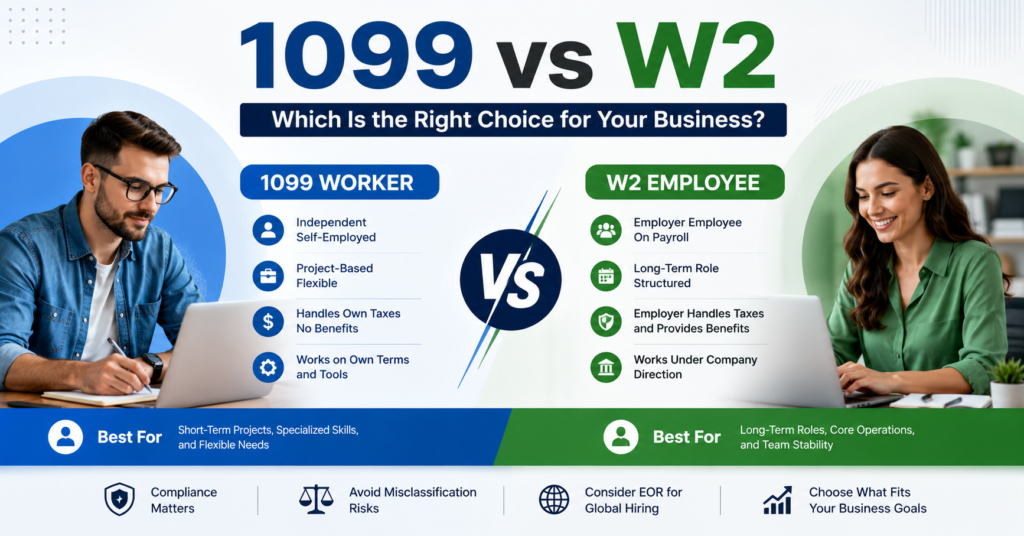
| Aspect | 1099 Worker | W2 Employee |
| Work Control | Works independently and decides how the work is completed | Employer defines schedule, tasks, and how work should be done |
| Taxes & Payments | Paid in full with no tax deductions; handles own tax payments | Employer deducts income tax, Social Security, and Medicare |
| Benefits | Does not receive company benefits | May receive benefits like health insurance, PTO, and retirement plans |
| Tools & Equipment | Uses their own tools and systems | Typically provided with company tools and resources |
| Legal Protection | Not covered under most employment laws | Protected by labor laws, including overtime and unemployment benefits |
| Cost for Business | No payroll taxes or benefits, but may charge higher rates | Includes salary plus taxes, benefits, and administrative costs |
| Work Duration & Flexibility | Usually hired for short-term or project-based work | Employed for long-term, ongoing roles with fixed structure |
| Misclassification Risk | Higher risk if role doesn’t meet independent criteria | Lower risk when properly classified, but requires compliance management |
Legal & Compliance Considerations
When choosing between a 1099 worker and a W2 employee, legal compliance is not something you can afford to overlook. Misclassification is one of the most common and costly mistakes businesses make, and it can lead to serious financial and legal consequences.
Here are the key compliance factors you need to understand:
- Worker Classification Rules: Authorities look at how much control you have over the worker, how the work is performed, and the nature of the relationship to determine the correct classification.
- Misclassification Risks: If a worker is incorrectly classified, your business may face penalties, back taxes, and even legal action.
- Tax Obligations: For W2 employees, you are responsible for withholding and paying payroll taxes. For 1099 workers, the individual handles their own taxes, but you must still report payments correctly.
- Employment Laws and Protections: W2 employees are covered by labor laws such as minimum wage, overtime, and workplace protections, while 1099 workers are generally not entitled to these benefits.
- Documentation and Agreements: Clear contracts and proper documentation are essential to define the working relationship and avoid disputes.
- State and Local Regulations: Laws can vary depending on location, and some regions have stricter rules around worker classification, making compliance even more important.
Managing these aspects manually can become complex, especially as your team grows. This is where solutions like Global Payroll Services can help streamline compliance and reduce administrative burden.
How to Decide Which One is Best for Your Business?
Choosing between a 1099 worker and a W2 employee depends on how the role fits into your business operations, not just the cost. A clear understanding of your needs will help you make the right decision from the beginning.
Here are the key factors to consider:
- Work Scope
If the role is short-term or project-based, a 1099 worker is suitable; ongoing responsibilities are better handled by a W2 employee. - Access to Talent
1099 professionals can help you tap into specialized skills that may be hard to find or not needed full-time. - Total Hiring Cost
1099 workers may charge higher rates, while W2 employees come with added costs like taxes, benefits, and paid time off. - Level of Control
If you need to manage schedules and workflows closely, a W2 employee is the better option. - Consistency and Availability
For roles that require regular hours and long-term reliability, W2 employees provide more stability. - Speed and Flexibility
1099 hiring allows you to move quickly and scale your team based on changing needs. - Compliance Risk
If the role closely resembles a full-time job, choosing W2 helps reduce the risk of misclassification.
If you’re planning to expand beyond local markets, having a structured approach to Global Talent Acquisition becomes important to find, hire, and manage the right talent efficiently.
How an Employer of Record (EOR) Simplifies Hiring?
An Employer of Record (EOR) makes hiring easier by taking care of the legal and administrative side of employment on your behalf. Instead of setting up a local entity or managing complex regulations, you can hire talent in different regions while the EOR handles compliance, payroll, and taxes.
Here’s how it simplifies the process:
- Handles Legal Compliance: The EOR ensures all employment laws, contracts, and regulations are followed, which reduces your risk.
- Manages Payroll and Taxes: They take care of salary payments, tax filings, and statutory deductions, so you don’t have to.
- Enables Global Hiring: You can hire talent in new countries without opening a local office or legal entity.
- Reduces Administrative Work: HR tasks like onboarding, documentation, and benefits management are handled for you.
- Faster Market Expansion: You can build teams quickly in new regions without delays caused by legal setup.
If you’re building remote or distributed teams, combining EOR with strong engagement strategies is important. You can explore ideas in our guide on Virtual Team Building Activities to keep your workforce aligned and productive.
Final Thoughts
Choosing between a 1099 worker and a W2 employee depends on your business needs, not just cost. If you need flexibility and short-term support, a 1099 setup works well. For long-term roles that require control and consistency, W2 employees are the better choice. It’s also important to consider compliance, as misclassification can lead to serious penalties.
For businesses planning to expand or hire across regions, an Employer of Record can simplify hiring while handling legal and payroll responsibilities. The right approach is to align your hiring model with your goals and use a mix of options where it makes the most sense.
FAQs
Is it better to hire 1099 or W2 workers?
It depends on the role. 1099 workers are better for short term or project based work where flexibility matters. W2 employees are ideal for long term roles that require consistency, control, and ongoing involvement in your business.
Can someone be both 1099 and W2?
Yes, but not for the same role in the same company. A person can work as a W2 employee for one job and take on 1099 work separately, as long as the roles and responsibilities are clearly different.
What are the tax differences between 1099 and W2?
For W2 employees, the employer handles tax deductions and payroll taxes. 1099 workers manage their own taxes, including self employment tax, which usually means higher individual tax responsibility.
What is the biggest risk of hiring 1099 workers?
The biggest risk is misclassification. If a worker should legally be a W2 employee but is treated as 1099, the business can face penalties, back taxes, and legal issues.
How does an Employer of Record help businesses?
An Employer of Record handles payroll, taxes, compliance, and legal responsibilities, allowing businesses to hire employees, especially in other regions, without setting up a local entity.