Key Takeaways
-
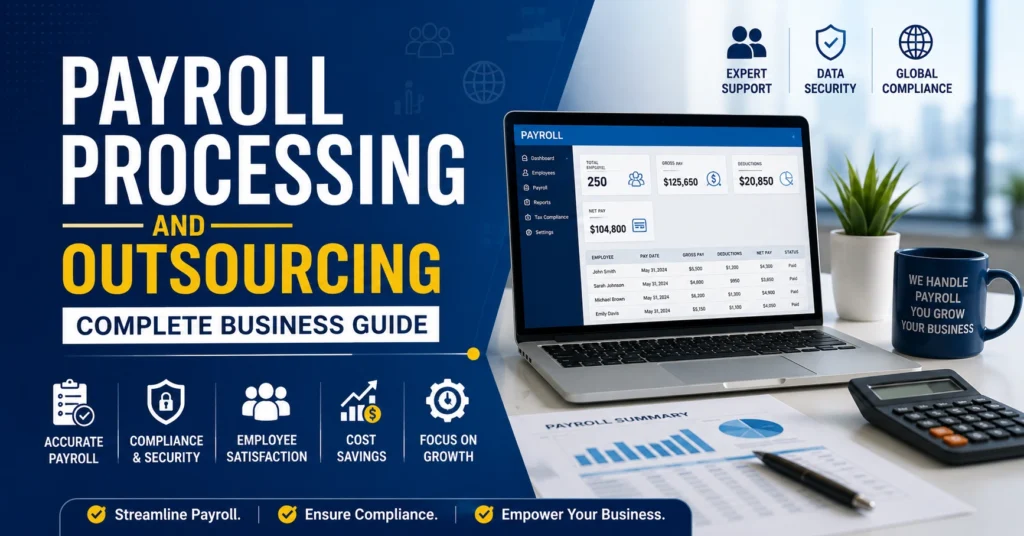
Payroll processing ensures employees are paid accurately and on time while meeting all statutory obligations.
-
Payroll outsourcing allows businesses to delegate payroll responsibilities to experienced professionals, reducing workload and compliance risks.
-
A well-managed payroll system improves employee satisfaction, business efficiency, and financial planning.
-
Choosing the right payroll provider helps minimize payroll errors, enhance data security, and streamline payroll administration.
-
Understanding payroll compliance is essential to avoid penalties and maintain legal compliance.
Payroll Processing & Outsourcing
Paying employees accurately and on time is one of the most important responsibilities of any business. However, payroll involves much more than calculating salaries. It includes managing attendance, deductions, taxes, statutory compliance, reimbursements, payslips, and maintaining accurate employee records. As businesses grow, handling these tasks manually becomes increasingly complex and time-consuming.
This is where Payroll Processing & Outsourcing becomes valuable. Whether you’re a startup, small business, or a large enterprise, an efficient payroll management system helps reduce errors, improve compliance, and save valuable time. [To complement your payroll operations and ensure predictable cash flow, explore our full range of accounts receivable services.] Businesses operating across multiple countries or planning international expansion often rely on global payroll services to manage payroll efficiently while staying compliant with local employment and tax regulations.
In this guide, you’ll learn about payroll processing and outsourcing, its benefits, common challenges, and how to choose the right payroll solution for your business.
What is Payroll Processing?
Payroll processing is the process of calculating employee salaries, deducting taxes and statutory contributions, generating payslips, and ensuring employees receive their salaries accurately and on time.
A complete payroll process includes collecting employee information, calculating gross and net salary, applying deductions such as income tax, provident fund, or insurance, processing reimbursements, and maintaining payroll records.
Regardless of company size, payroll is an essential business function because employee salaries directly impact workforce satisfaction and business operations.
An efficient payroll management system ensures:
-
Accurate salary calculations
-
Timely salary payments
-
Compliance with government regulations
-
Proper employee record management
-
Error-free payroll reports
-
Better financial planning
Modern businesses often use payroll software or cloud-based payroll solutions to automate repetitive tasks and improve payroll accuracy.
How Payroll Processing Works?
Although payroll may appear simple, it involves multiple stages that must be completed accurately during every payroll cycle.
1. Collect Employee Information
The process begins by gathering employee details such as:
-
Employee ID
-
Salary structure
-
Bank account details
-
Tax information
-
Employment status
-
Department and designation
2. Record Attendance and Leave
Attendance, overtime, work hours, leave records, and holiday information are collected from attendance management systems. Incorrect attendance records often result in salary disputes, which makes this step extremely important.
3. Calculate Gross Salary
Gross salary includes all earnings such as:
-
Basic salary
-
House rent allowance
-
Conveyance allowance
-
Bonuses
-
Incentives
-
Overtime payments
-
Performance rewards
Each component is added according to the employee’s salary structure.
4. Apply Deductions
After calculating gross salary, payroll administrators deduct applicable amounts, including:
-
Income tax
-
Provident Fund (PF)
-
Employee State Insurance (ESI)
-
Professional Tax
-
Loan deductions
-
Leave without pay
-
Other statutory deductions
These deductions determine the employee’s net salary.
5. Generate Payslips
A detailed payslip is prepared showing:
-
Earnings
-
Deductions
-
Net salary
-
Tax details
-
Employer contributions
Payslips improve transparency and help employees understand their salary breakdown.
6. Salary Disbursement
Once payroll is verified, salaries are transferred directly to employees’ bank accounts through secure payment systems.
7. Payroll Reporting
The final stage involves preparing payroll reports for finance, HR, compliance, and auditing purposes. Reports help management analyze payroll costs, workforce expenses, and future budgeting.
Key Components of Payroll Processing
Successful payroll processing depends on several interconnected components.
-
Employee Information Management: Maintaining updated employee records ensures salaries are processed without delays or calculation errors.
-
Salary Structure: Every employee may have a different compensation package. A payroll system should support multiple salary structures, allowances, and benefits.
-
Attendance and Leave Management: Integrating attendance with payroll reduces manual work and improves salary accuracy.
-
Tax Calculations: Payroll software automatically calculates applicable taxes based on current regulations, reducing compliance risks.
-
Statutory Compliance: Businesses must comply with labor laws and statutory regulations. Missing deadlines or filing incorrect information can lead to penalties.
-
Employee Benefits: Payroll includes employee benefits such as bonuses, reimbursements, insurance, retirement contributions, and incentives.
-
Payroll Records: Maintaining payroll records is essential for audits, employee verification, financial reporting, and legal compliance.
What is Payroll Outsourcing?
Payroll outsourcing is the process of hiring a specialized payroll company or payroll service provider to manage payroll activities on behalf of a business.
Instead of handling payroll internally, organizations rely on experienced payroll professionals who use advanced payroll software and established processes to manage salary calculations, tax deductions, compliance, and salary payments.
Payroll outsourcing services are increasingly popular among startups, SMEs, and large enterprises because they reduce administrative workload while improving payroll accuracy.
An outsourced payroll provider typically manages:
-
Salary processing
-
Employee payroll calculations
-
Tax deductions
-
Payslip generation
-
Compliance reporting
-
Payroll administration
-
Record management
-
Payroll support
Businesses can focus on their core operations while payroll experts handle complex payroll responsibilities.
How Payroll Outsourcing Works?
The outsourcing process follows a structured workflow.
1. Employee Data Collection
The business shares employee information, attendance records, salary revisions, and reimbursement details with the payroll provider.
2. Payroll Calculation
The payroll provider calculates employee salaries using automated payroll software while considering deductions, bonuses, and applicable taxes.
3. Compliance Verification
Before payroll is finalized, all statutory deductions and tax calculations are reviewed to ensure compliance with current laws.
4. Payslip Generation
Employees receive professionally generated digital payslips that include a complete salary breakdown.
5. Salary Processing
After approval from the employer, salaries are transferred to employees through secure banking channels.
6. Reporting and Support
The payroll outsourcing company prepares payroll reports and provides ongoing support for audits, tax filings, employee queries, and compliance documentation.
Types of Payroll Outsourcing
Businesses can choose different payroll outsourcing models based on their size, budget, and operational requirements.
1. Full Payroll Outsourcing
In this model, the payroll provider manages the complete payroll process from salary calculations to statutory compliance and reporting. This option is ideal for businesses that want to eliminate the administrative burden of payroll management.
2. Partial Payroll Outsourcing
Some companies prefer to manage attendance and employee records internally while outsourcing salary calculations, tax filing, or compliance tasks. This model provides greater operational flexibility.
3. Cloud-Based Payroll Services
Cloud payroll solutions allow employers to access payroll information securely from anywhere. These systems offer real-time reporting, automated updates, employee self-service portals, and seamless integration with HR software.
4. Managed Payroll Services
Managed payroll services combine payroll software with dedicated payroll experts who ensure every payroll cycle is completed accurately and on schedule.
5. International Payroll Outsourcing
Businesses operating in multiple countries often outsource payroll to providers with expertise in international tax regulations, local labor laws, and multi-currency payroll processing. This is especially beneficial for organizations looking to hire international employees, as it helps ensure accurate payroll processing while staying compliant with country-specific tax and employment regulations.
Payroll Processing vs Payroll Outsourcing
Although the terms payroll processing and payroll outsourcing are often used interchangeably, they refer to different aspects of payroll management. Payroll processing is the activity of calculating salaries and managing payroll tasks, while payroll outsourcing is the practice of assigning those responsibilities to an external payroll service provider.
| Feature | Payroll Processing | Payroll Outsourcing |
| Definition | Managing payroll activities within the organization | Hiring an external payroll provider to handle payroll |
| Responsibility | HR or finance team | Professional payroll company |
| Cost | Depends on software, staff, and infrastructure | Service-based pricing |
| Compliance | Managed internally | Managed by payroll experts |
| Control | Full control over payroll | Shared control with the service provider |
| Technology | Requires payroll software and maintenance | Provider manages the technology |
| Scalability | Limited by internal resources | Easily scalable as the business grows |
| Best For | Businesses with dedicated HR and payroll teams | Startups, SMEs, and growing enterprises |
Why Payroll Processing is Important for Every Business?
It directly impacts employee trust, business reputation, financial planning, and legal compliance. Below are some reasons that makes payroll processing important.
-
Ensures Accurate Salary Payments: Employees expect their salaries to be paid correctly and on time. An efficient payroll management system minimizes calculation errors and builds confidence among employees.
-
Supports Payroll Compliance: Every business must comply with applicable tax laws and employment regulations. Proper payroll processing ensures statutory deductions are calculated correctly and filed within deadlines, reducing the risk of penalties.
-
Improves Employee Satisfaction: Late or inaccurate salary payments can damage employee morale. A reliable payroll process creates a positive employee experience by ensuring transparency through detailed payslips and timely payments.
-
Saves Time and Administrative Effort: Automated payroll software reduces repetitive manual tasks, allowing HR teams to focus on recruitment, employee engagement, and strategic initiatives instead of routine payroll administration.
-
Enhances Financial Planning: Payroll is one of the largest recurring business expenses. Accurate payroll reports help management forecast costs, manage cash flow, and make informed budgeting decisions.
-
Builds Business Credibility: Consistent payroll practices demonstrate professionalism and strengthen trust among employees, investors, and regulatory authorities.
Benefits of Payroll Outsourcing
Below are the benefits of payroll outsourcing.
-
Saves Valuable Time: Payroll involves calculations, compliance checks, and reporting. Outsourcing these tasks allows business owners and HR teams to focus on core business activities while spending more time on strategic priorities like talent acquisition strategy instead of routine payroll administration.
-
Reduces Operational Costs: Businesses can avoid the expenses of maintaining payroll software, hiring specialists, and managing payroll internally, making outsourcing a cost-effective option.
-
Improves Payroll Accuracy: Professional payroll providers use automated systems and standardized processes to reduce calculation errors and ensure accurate salary payments.
-
Keeps Your Business Compliant: Payroll providers stay updated with changing tax laws and labor regulations, helping businesses maintain compliance and avoid penalties.
-
Access to Payroll Experts: Experienced professionals handle salary calculations, statutory deductions, tax filings, and payroll reporting with accuracy.
-
Better Data Security: Outsourcing partners use secure payroll systems, encryption, and access controls to protect sensitive employee information.
-
Easy Scalability: Payroll services can easily adapt to business growth, new hires, and multiple locations without adding internal workload.
-
Faster Payroll Processing: Dedicated payroll teams ensure timely salary processing, payslip generation, and on-time employee payments.
-
Improved Reporting and Insights: Detailed payroll reports help businesses track labor costs, tax liabilities, and workforce expenses for better financial planning.
Payroll Processing Challenges Businesses Face
Even with modern payroll software, businesses can face several payroll challenges. Identifying these issues early helps improve efficiency and reduce compliance risks.
-
Manual Calculation Errors: Manual payroll processing can lead to mistakes in salary calculations, deductions, and overtime, resulting in payment errors and extra administrative work.
-
Frequent Compliance Changes: Constant updates to tax laws and labor regulations make it difficult for businesses to stay compliant without regular monitoring.
-
Managing Employee Attendance: Inaccurate attendance records can affect salary calculations. Integrating attendance with payroll helps improve accuracy.
-
Complex Salary Structures: Managing bonuses, incentives, reimbursements, and different pay components manually increases the risk of payroll errors.
-
Payroll Deadlines: Delayed payroll processing can impact employee trust. A well-managed payroll process ensures timely salary payments.
-
Data Security Risks: Payroll contains sensitive employee information that must be protected through secure systems and controlled access.
-
Handling a Growing Workforce: As businesses expand, payroll becomes more complex. Automation and expert support help manage increasing payroll demands efficiently.
Signs Your Business Needs Payroll Outsourcing
Many businesses continue managing payroll internally even when the process has become inefficient. Recognizing the right time to outsource payroll can improve accuracy, reduce workload, and strengthen compliance.
-
Payroll Takes Too Much Time: If your HR or finance team spends several days each month processing salaries, outsourcing can significantly improve productivity.
-
Frequent Payroll Errors: Recurring mistakes in salary calculations, tax deductions, or payslips indicate that your existing payroll process needs improvement.
-
Compliance Issues: If your business struggles to keep up with changing payroll regulations or has received compliance notices, outsourcing payroll can reduce these risks.
-
Rapid Business Growth: As your workforce expands, payroll complexity also increases. Outsourced payroll providers have the systems and expertise to manage larger employee databases efficiently.
-
HR Team Is Overloaded: HR professionals should focus on talent acquisition, employee development, and organizational growth. Outsourcing payroll frees them from repetitive administrative work.
-
Multiple Office Locations: Businesses operating across different cities or countries often deal with varying tax rules and employment regulations. Payroll providers can manage these complexities more effectively.
-
Lack of Payroll Expertise: If your organization does not have dedicated payroll professionals, outsourcing ensures that payroll is handled by experienced specialists using proven processes and advanced payroll solutions.
Features to Look for in a Payroll Outsourcing Provider
Choosing the right payroll outsourcing company is just as important as deciding to outsource payroll itself. Before making a decision, evaluate the provider based on the following factors.
-
Payroll Automation: A modern provider should use payroll automation to reduce manual work, improve accuracy, and speed up salary processing. Automated payroll systems also minimize human errors and ensure consistent payroll cycles.
-
Compliance Expertise: Payroll regulations are constantly evolving. Your provider should have in-depth knowledge of payroll compliance requirements, including tax laws, statutory deductions, and labor regulations. This helps your business avoid penalties and remain legally compliant.
-
Data Security: Payroll data includes sensitive employee information such as salary details, tax records, and bank account numbers. Choose a provider that follows strong security practices like data encryption, secure servers, role-based access, and regular system audits.
-
Scalable Payroll Solutions: As your business expands, your payroll needs will also change. A good provider should offer flexible payroll solutions that can handle workforce growth, multiple office locations, and changing compensation structures without disrupting payroll operations.
-
Employee Self-Service Portal: An employee self-service portal allows staff to download payslips, view tax documents, update personal details, and access payroll information independently. This reduces the workload on HR teams while improving the employee experience.
-
Integration with HR Systems: The best HR payroll services integrate seamlessly with attendance systems, leave management software, HRMS platforms, and accounting tools. This eliminates duplicate data entry and improves overall efficiency.
-
Transparent Pricing: Understand the provider’s pricing model before signing a contract. Look for transparent pricing without hidden charges. Compare the services offered to ensure you’re getting value for your investment.
-
Dedicated Customer Support: Payroll issues often require immediate attention. A responsive support team ensures that salary queries, compliance concerns, and technical issues are resolved quickly.
Payroll Compliance You Should Know
Payroll compliance refers to following all applicable employment laws, tax regulations, and statutory obligations while processing employee salaries.
Some of the most important areas of payroll compliance include:
-
Income Tax (TDS): Businesses must deduct Tax Deducted at Source (TDS) from employee salaries wherever applicable and deposit it with the relevant tax authorities within the timelines.
-
Provident Fund (PF): Eligible employers are required to contribute to the Employees’ Provident Fund (EPF) on behalf of their employees. Timely contributions and accurate reporting are essential for compliance.
-
Employee State Insurance (ESI): Organizations meeting the eligibility criteria must contribute to the Employee State Insurance scheme to provide medical and social security benefits to eligible employees.
-
Professional Tax: Professional tax is applicable in certain states and varies based on local regulations. Businesses must calculate, deduct, and deposit the tax according to the rules of the respective state.
-
Gratuity and Bonus: Eligible employees are entitled to gratuity and statutory bonus under applicable labor laws. Employers should maintain proper records and ensure timely payments wherever required.
-
Payroll Documentation: Accurate payroll records, salary registers, tax filings, attendance reports, and employee declarations should be maintained for audits, financial reporting, and legal purposes.
Final Thoughts
Effective payroll management is essential for every business, regardless of its size. A well-structured payroll process ensures employees are paid accurately, statutory obligations are met, and administrative tasks are handled efficiently. As payroll becomes more complex with business growth, payroll outsourcing can help reduce errors, save time, and improve compliance while allowing HR teams to focus on strategic priorities.
[To build a complete, end-to-end financial system across all your operations, explore our broad range of finance solutions.] Whether you choose in-house payroll or partner with a trusted payroll provider, investing in the right payroll management system and processes will improve operational efficiency, strengthen employee trust, and support your organization’s long-term growth.
Frequently Asked Questions
What should businesses look for in a payroll provider?
Choose a provider that offers payroll automation, compliance expertise, data security, HR software integration, transparent pricing, scalability, and reliable customer support.
Can payroll outsourcing reduce payroll errors?
Yes. Experienced payroll professionals use standardized processes and automated systems to minimize calculation errors and improve payroll accuracy.
Is cloud-based payroll secure?
Reputable cloud payroll providers use advanced encryption, secure servers, regular backups, and access controls to protect sensitive payroll information.
What industries benefit most from payroll outsourcing?
Industries such as IT, manufacturing, healthcare, retail, hospitality, logistics, construction, startups, and professional services commonly use payroll outsourcing to simplify payroll administration.
How do payroll services support business growth?
Payroll services streamline payroll administration, improve compliance, reduce HR workload, and provide scalable solutions that adapt as the workforce expands.